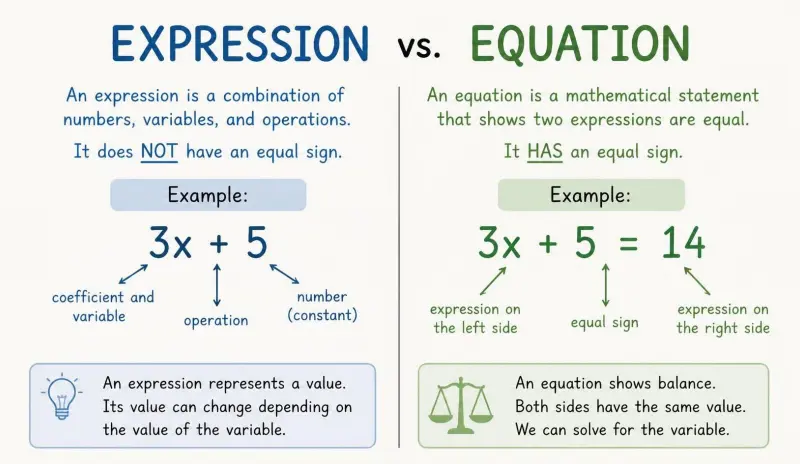
An expression is a combination of numbers, variables, and mathematical operations without an equals sign, such as 3x + 5. An equation connects two expressions with an equals sign, such as 3x + 5 = 20. Expressions are usually simplified or evaluated, while equations are solved to find values that make the statement true.
Key Takeaways
- An expression does not make an equality statement.
- An equation contains an equals sign (=) connecting two expressions.
- You normally simplify or evaluate an expression.
- You solve an equation to find an unknown value.
- Expressions can appear on either side of an equation.
- The fastest way to identify the difference is to look for the equals sign.
What Is an Expression in Math?
A mathematical expression is a number, variable, or combination of numbers and variables joined by mathematical operations. It can include addition, subtraction, multiplication, division, exponents, parentheses, and other mathematical notation.
For example:
- 7 + 3
- x + 8
- 4y – 6
- 3x² + 2x – 5
- 2(a + 4)
None of these contains an equals sign. Therefore, each one is an expression.
Think of an expression as a mathematical phrase. It represents a quantity, but by itself it does not state that one quantity is equal to another. OpenStax similarly describes an expression as a number, variable, or combination of numbers and variables using operation symbols.
Examples of Expressions
Consider 5x + 2.
This expression contains:
- 5 — a coefficient
- x — a variable
- + — an addition operation
- 2 — a constant
Together, these parts form one expression.
Another example is 12 – 4. It is still an expression even though it contains only numbers.
You can calculate its value:
12 – 4 = 8
The original 12 – 4 is the expression. The calculation gives its value.
Parts of an Expression
Expressions often contain several important parts:
| Part | Example in 4x + 7 |
|---|---|
| Coefficient | 4 |
| Variable | x |
| Constant | 7 |
| Operator | + |
| Terms | 4x and 7 |
Understanding these parts becomes useful when you simplify, factor, or evaluate algebraic expressions.
What Is an Equation in Math?
An equation is a mathematical statement that says two expressions have the same value. It uses an equals sign (=) to connect the two sides.
For example:
3x + 5 = 20
The left side is the expression 3x + 5.
The right side is the expression 20.
The equals sign states that these two expressions have the same value when the equation is true.
Other examples include:
- x + 4 = 10
- 2y = 18
- 5 + 7 = 12
- a² + b² = c²
Notice that an equation does not necessarily need a variable. 5 + 7 = 12 is an equation because it states that two expressions have equal values.
The Role of the Equal Sign
The equals sign is the easiest clue when identifying an equation.
It does not simply mean “here comes the answer.” Instead, it means “is equal to.”
For example:
x + 3 = 9
can be read as:
“x plus 3 is equal to 9.”
This makes an equation a complete mathematical statement. OpenStax explains the same idea by describing an equation as two expressions linked by an equal sign.
Expression vs Equation: The Main Difference
The biggest difference between an expression and an equation is the equals sign.
| Feature | Expression | Equation |
|---|---|---|
| Equals sign | No | Yes |
| Structure | Numbers, variables, and operations | Two expressions connected by = |
| Main purpose | Represent a quantity | State an equality |
| Common task | Simplify or evaluate | Solve |
| Example | 4x + 7 | 4x + 7 = 19 |
| Has a solution? | Not in the equation-solving sense | Yes, when applicable |
For example, compare these two:
Expression:
2x + 6
Equation:
2x + 6 = 14
The first simply represents a quantity.
The second makes a statement about that quantity and gives you a relationship to work with.
This distinction is also reflected in standard algebra instruction, where students learn to evaluate expressions and solve equations as related but different skills.
How to Tell If Something Is an Expression or Equation
Use this simple rule:
Look for the equals sign (=).
- If there is no equals sign, it is generally an expression.
- If an equals sign connects two expressions, it is an equation.
Try these examples:
- 8x + 2 → Expression
- 8x + 2 = 18 → Equation
- 15 – 7 → Expression
- 15 – 7 = 8 → Equation
- y/3 → Expression
- y/3 = 5 → Equation
This rule works for many beginner algebra problems.
However, remember that mathematical notation can include other relationships, such as inequalities. An inequality like x > 5 is neither an expression nor an equation in the strict comparison sense; it is an inequality.
Expressions Are Simplified or Evaluated
One major difference appears in the type of work you do with each mathematical object.
You typically simplify an expression when you want to rewrite it in an equivalent, easier form.
For example:
3x + 2x + 4
Combine the like terms:
5x + 4
You did not find a value for x. Instead, you simplified the expression.
You can also evaluate an expression when you know the value of its variable.
Suppose:
x = 3
and the expression is:
2x + 5
Substitute 3 for x:
2(3) + 5 = 6 + 5 = 11
So, the value of the expression is 11.
OpenStax defines evaluating an expression as finding its value after replacing variables with given numbers.
Equations Are Solved
When you have an equation, you often want to find the value of an unknown variable that makes both sides equal.
Consider:
3x + 5 = 20
Subtract 5 from both sides:
3x = 15
Then divide both sides by 3:
x = 5
So, 5 is the solution because putting 5 in place of x makes the equation true:
3(5) + 5 = 20
15 + 5 = 20
20 = 20
This is why it is useful to remember:
Expressions are commonly simplified or evaluated. Equations are commonly solved.
That simple distinction can prevent many beginner algebra mistakes.
Expression vs Equation in Word Problems
Expressions and equations also appear when you translate words into mathematics.
For example, suppose a movie ticket costs $12, and you buy x tickets.
The total cost can be represented by the expression:
12x
That tells you the cost, but it does not give a specific number of tickets.
Now suppose the total cost is $60.
You can write an equation:
12x = 60
Now you have a mathematical relationship that can be solved:
x = 5
This shows how expressions and equations can work together. An expression can describe a quantity, while an equation can connect that quantity to another known value.
Educational algebra materials commonly teach students to translate mathematical phrases into expressions and mathematical sentences into equations.
Common Mistakes Students Make
Mistake 1: Thinking every math problem is an equation
A problem such as:
4x + 7
is not an equation because it does not contain an equals sign.
You cannot solve it for x unless additional information is provided.
Mistake 2: Treating the equals sign as “the answer is”
The equals sign means that the expressions on both sides have the same value.
For example:
4 + 3 = 7
means that 4 + 3 has the same value as 7.
It does not simply mean “4 + 3 gives the answer 7.”
Mistake 3: Confusing evaluating with solving
If you are told x = 4 and asked to evaluate 3x + 2, substitute the value:
3(4) + 2 = 14
You are not solving for x because x is already known.
On the other hand:
3x + 2 = 14
asks you to find the value of x. That is an equation-solving task.
Mistake 4: Assuming equations must contain variables
An equation can be entirely numerical.
For example:
10 + 5 = 15
is an equation.
It contains no variable, but it still states that two expressions have equal values.
Expression vs Equation Examples
Here are several quick examples to reinforce the difference:
| Mathematical Statement | Type | Why? |
|---|---|---|
| 7 + 9 | Expression | No equals sign |
| 7 + 9 = 16 | Equation | Has an equals sign |
| 4x – 3 | Expression | Represents a quantity |
| 4x – 3 = 17 | Equation | Connects two expressions |
| a² + 5 | Expression | No equality statement |
| a² + 5 = 30 | Equation | States both sides are equal |
| 20 ÷ 4 | Expression | No equals sign |
| 20 ÷ 4 = 5 | Equation | Contains equality |
A useful memory trick is:
Expression = mathematical phrase.
Equation = mathematical statement.
The distinction is simple, but it becomes increasingly important as you study algebra, functions, formulas, and more advanced mathematics.
Frequently Asked Questions
Is 2x + 5 an expression or an equation?
2x + 5 is an expression because it does not contain an equals sign. It represents a quantity whose value depends on x. If you write 2x + 5 = 15, it becomes part of an equation.
Is x = 5 an equation?
Yes. x = 5 is an equation because the equals sign connects the expression x with the expression 5. It states that x and 5 have the same value.
Can an expression have an equal sign?
In standard elementary and algebra terminology, an expression itself does not contain an equality statement. Once an equals sign connects two expressions, you have an equation. Other mathematical notation can use related symbols, but the basic expression-versus-equation distinction uses the equals sign as the key clue.
Do you solve an expression?
Usually, no. You simplify or evaluate an expression. For example, you can simplify 3x + 2x to 5x, or evaluate 3x + 2 when a value for x is given. You solve an equation, such as 3x + 2 = 17.
What is the easiest way to remember expression vs equation?
Look for the equals sign. No equals sign = expression. Equals sign connecting two sides = equation. Then remember the common tasks: simplify or evaluate expressions, and solve equations.
Final Difference: Expression vs Equation
The difference between an expression vs equation is straightforward once you focus on the equals sign.
An expression combines numbers, variables, and mathematical operations to represent a quantity. Examples include 4x + 3, 7y, and 12 – 5.
An equation connects two expressions with an equals sign and states that they have the same value. Examples include 4x + 3 = 19 and 12 – 5 = 7.
When working with expressions, you will often simplify or evaluate them. When working with equations, you will often solve them to find unknown values.
Once you learn this basic distinction, many algebra instructions become easier to understand.

James Baldwin was a fearless American writer and activist, exploring race, identity, and justice with sharp honesty. Read inspiring literary bios on punsora.com for readers seeking truth, courage, and insight.