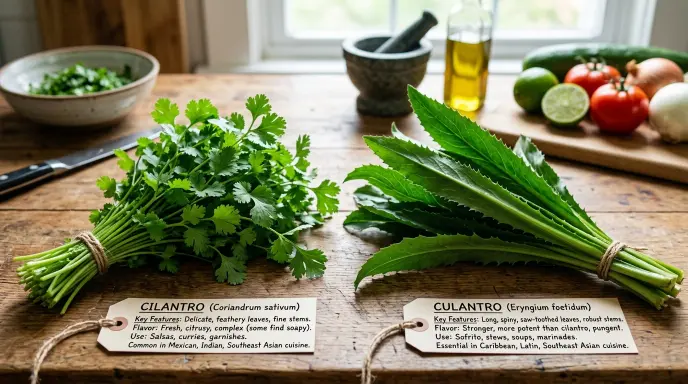
Cilantro and culantro are different herbs, although they belong to the same plant family and have similar aromas. Cilantro (Coriandrum sativum) has delicate, rounded leaves and a bright citrusy flavor. Culantro (Eryngium foetidum) has long, sturdy, serrated leaves and a stronger, more pungent flavor. They overlap in some recipes, but they are not interchangeable in every dish.
Key Takeaways
- Cilantro and culantro are different species in the same plant family, Apiaceae.
- Cilantro has soft, delicate leaves and a bright, fresh flavor.
- Culantro has long, toothed leaves and a more intense flavor that holds up better during cooking.
- Cilantro is common in Mexican, Indian, Middle Eastern, and many Asian dishes, while culantro is especially important in Caribbean and Latin American cooking.
- You can substitute one for the other in some recipes, but the flavor and cooking results will not be identical.
What Is the Difference Between Cilantro and Culantro?
The easiest way to understand cilantro vs culantro is to think of them as related herbs rather than two names for the same plant.
Cilantro is the leafy herb from Coriandrum sativum. In the United States, the fresh leaves and stems are generally called cilantro, while the plant’s dried mature seeds are called coriander. Cilantro is an annual herb that grows best in cooler conditions and can bolt quickly in hot weather. PPlants of the World Online+1
Culantro comes from a completely different genus and species: Eryngium foetidum. It is a tropical herb in the same Apiaceae family as cilantro, parsley, carrots, and celery. Kew lists its native range from Mexico through tropical America, and it is especially associated with warm, wet climates. PPlants of the World Online+1
So, is culantro just another type of cilantro? No. Their similar names and related flavor are the main reasons they are confused.
Cilantro at a glance
Cilantro has small, soft, green leaves that are somewhat rounded and divided. The leaves grow on thin stems and have a delicate texture.
Its flavor is commonly described as fresh, citrusy, grassy, and pungent. Some people also perceive cilantro as soapy because genetic differences can affect how certain aroma compounds are detected. Research has identified associations between this perception and variants near olfactory-receptor genes. DDOI
Culantro at a glance
Culantro looks dramatically different. Its leaves are long, firm, and narrow with pronounced serrated or toothed edges. They typically grow in a low rosette rather than as the delicate leafy sprigs associated with cilantro. GGardening Solutions+1
Its aroma resembles cilantro, but its flavor is generally more intense and pungent. The tougher leaves also make culantro better suited to dishes where an herb needs to withstand cooking.
Cilantro vs Culantro: Side-by-Side Comparison
FeatureCilantroCulantroScientific nameCoriandrum sativumEryngium foetidumPlant familyApiaceaeApiaceaeLeaf shapeSmall, delicate, dividedLong, sturdy, serratedFlavorBright, citrusy, grassyStronger, pungent, earthy/citrusyTextureSoft and tenderFirm and tougherClimatePrefers cooler growing conditionsThrives in warm conditionsCommon namesCilantro, coriander leaf, Chinese parsleyCulantro, recao, sawtooth coriander, long coriander, ngo gaiCommon culinary roleFresh garnish and ingredientFresh herb and cooked seasoningAvailability in the U.S.Widely availableMore common at specialty markets
The botanical difference is especially important: although both belong to Apiaceae, cilantro belongs to Coriandrum, while culantro belongs to Eryngium. PPlants of the World Online+1
How Do Cilantro and Culantro Taste?
Cilantro generally delivers a lighter, brighter flavor. It works particularly well when you want a fresh herbal note at the end of cooking.
Culantro has a similar general flavor direction but is more forceful. The University of Florida’s IFAS Extension describes its leaves as smelling similar to cilantro while producing a stronger flavor. GGardening Solutions
That difference matters when cooking. A large handful of culantro can dominate a dish where the same amount of cilantro would simply add freshness.
The two herbs also react differently to heat. Cilantro’s delicate leaves and aroma make it especially useful in fresh preparations or as a finishing herb. Culantro’s sturdier leaves are well suited to cooked dishes and seasoning bases.
How Are Cilantro and Culantro Used in Cooking?
Best uses for cilantro
Cilantro is common in dishes where fresh flavor is important. Think salsa, guacamole, tacos, salads, chutneys, soups, noodle dishes, and curries.
It is often added near the end of cooking or sprinkled over a finished dish. Its soft leaves are also easy to chop and mix into sauces.
Cilantro is used across many cuisines, including Mexican, Indian, Middle Eastern, and Asian cooking. PPlants of the World Online+1
Best uses for culantro
Culantro has a particularly strong connection to Caribbean and Latin American cooking. In Puerto Rico, for example, it is known as recao and is used in traditional cooking, including sofrito. The University of Florida also notes its use in sauces, rice, stews, soups, chutneys, salsa, and ceviche. GGardening Solutions+1
Culantro is also known as sawtooth coriander, long coriander, and ngo gai in different culinary contexts.
Because the leaves are tougher, finely chopping culantro is usually a better approach than leaving large pieces in a finished dish. Its stronger flavor also means that a little can go a long way.
Can You Substitute Culantro for Cilantro?
Yes, but the result will change.
If a recipe calls for cilantro and you use culantro, expect a stronger, more concentrated herbal flavor. This can work particularly well in cooked dishes, sauces, beans, stews, and seasoning mixtures.
Going the other direction is also possible. Cilantro is generally the more practical substitute when a recipe calls for culantro because it is easier to find in U.S. grocery stores. However, cilantro is less intense and tends to lose its fresh character more quickly with prolonged cooking. SSPICEography+1
There is no universal substitution ratio that works for every recipe. The best approach is to start conservatively and adjust to taste. This is especially important with culantro because its flavor can vary in intensity depending on the amount used and how it is prepared.
For a Puerto Rican sofrito or another dish where culantro is a defining ingredient, using the real herb will give you a more characteristic result than simply replacing it with cilantro.
Why Is Culantro Called Different Names?
Culantro has many regional names, which can make shopping for it confusing.
Depending on the market or cuisine, you may see names such as:
- Recao — particularly associated with Puerto Rican cooking
- Chadon beni — common in parts of the Caribbean
- Ngo gai — commonly used in Vietnamese markets
- Sawtooth coriander — a reference to its serrated leaves
- Long coriander
- Mexican coriander
Kew records numerous common names for Eryngium foetidum, reflecting its wide use across tropical regions. PPlants of the World Online
This also explains why searching only for “culantro” may not always produce the best shopping results.
How to Buy and Store Culantro
In the United States, culantro is less commonly stocked than cilantro. You are more likely to find it at Caribbean, Latin American, or Asian specialty markets than at a conventional supermarket. MMartha Stewart+1
Look for firm, green leaves without extensive yellowing or damage. Because the leaves are tougher than cilantro, they should generally be chopped finely before adding them to food.
Fresh culantro does not keep particularly well, so buy only what you expect to use. If you find more than you need, freezing chopped or prepared culantro can help preserve it for cooked dishes. GGardening Solutions+1
Frequently Asked Questions
Is culantro the same as cilantro?
No. Cilantro is Coriandrum sativum, while culantro is Eryngium foetidum. They belong to the same Apiaceae family and have related aromas and flavors, but they are different plants with noticeably different leaves and culinary characteristics. PPlants of the World Online+1
Is culantro stronger than cilantro?
Generally, yes. Culantro has a more intense, pungent flavor and aroma than cilantro. Its flavor also holds up better in cooked dishes, while cilantro is commonly used fresh or added near the end of cooking. GGardening Solutions+1
What is another name for culantro?
Culantro is also called recao, chadon beni, sawtooth coriander, long coriander, Mexican coriander, and ngo gai. The exact name depends on the region and cuisine. In Vietnamese markets, for example, you may see it labeled ngo gai. PPlants of the World Online+1
Can you use cilantro instead of culantro?
Yes, cilantro can work when culantro is unavailable, particularly in sauces, soups, stews, and seasoning mixtures. However, cilantro is milder and more delicate, so the finished dish will not taste exactly the same. For recipes where culantro is a signature ingredient, the original herb is preferable.
Conclusion
The main difference in cilantro vs culantro is simple: they are related but distinct herbs.
Cilantro has delicate leaves, a bright citrusy character, and a strong role in fresh dishes and garnishes. Culantro has long, serrated leaves and a more powerful flavor that works especially well in Caribbean and Latin American cooking and can stand up to heat.
If you see a recipe calling for culantro, do not assume it is a typo for cilantro. Check the ingredient carefully. And if you cannot find culantro, cilantro can provide a useful approximation—but expect a lighter and somewhat different flavor.