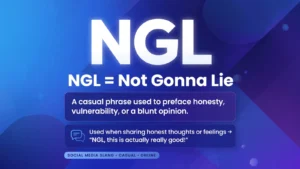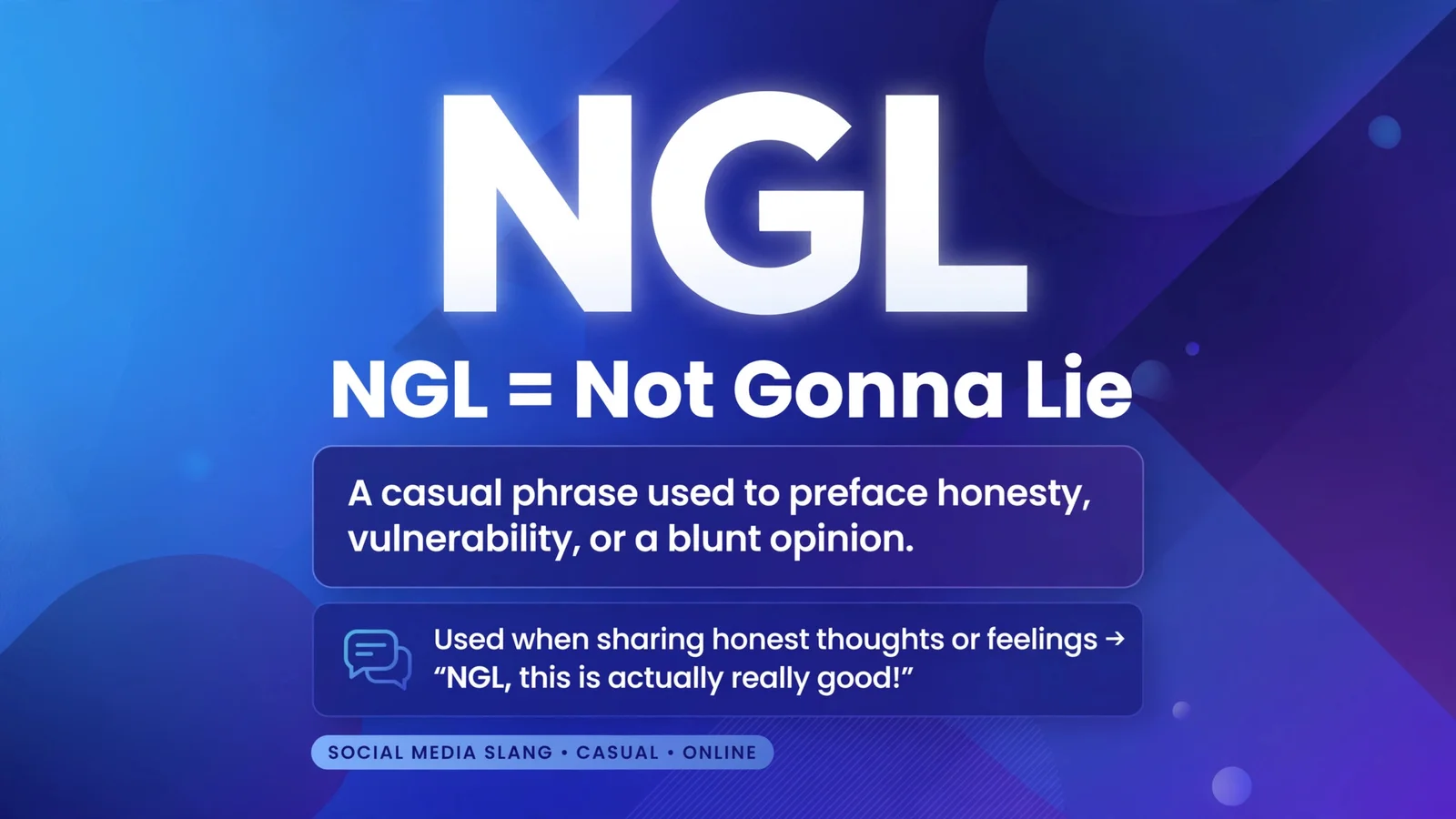
If you have seen a message start with “NGL” before an honest opinion, you may wonder what the letters stand for. NGL is internet slang for “Not Gonna Lie,” and it ranks among America’s most searched texting abbreviations. People use it to signal that an honest — sometimes blunt — opinion is coming.
The abbreviation became popular across texting and social media because it softens honesty with a casual warning. Its meaning stays consistent, but the tone can range from friendly confession to brutally honest hot take.
Understanding NGL meaning can help you read texts, comments, reviews, and captions more easily. This guide explains what the term stands for, how people use it in different situations, what it means on each platform, and how it compares to similar expressions.
NGL Meaning & Definition
NGL is an abbreviation of the phrase “Not Gonna Lie.” In texting and online slang, people place it before a statement to signal that they are about to be honest, even if the opinion might be unpopular, surprising, or slightly uncomfortable.
For example, if your friend asks what you thought of a movie everyone loves, you might reply, “NGL, I thought it was boring.” The NGL warns them that an unpopular opinion is coming.
The phrase works like a verbal disclaimer. It tells the reader: “I’m about to be straight with you.”
In everyday online language, the term generally introduces honesty, not deception. It is the opposite of lying — it is a promise of bluntness.
Background and Origin of NGL
NGL developed as a shortened form of “not gonna lie,” following the common internet habit of compressing conversational phrases into quick abbreviations. Similar honesty-markers appear throughout texting culture, where tone is hard to read.
The phrase “not gonna lie” comes from spoken English, where people have long used it to preface candid statements. The abbreviated form emerged with text messaging and social media, where brevity is valued.
The term became strongly associated with opinion culture online, especially on TikTok, X, Instagram, and Reddit. Hot takes, unpopular opinions, reviews, and confession-style content helped spread it, and it is now widely recognizable slang.
The meaning has stayed stable. NGL has consistently meant “Not Gonna Lie” since it appeared, and it functions the same way in 2026 as it did when it first spread.
How NGL Is Used in Chat, WhatsApp, Instagram, and TikTok
The meaning of NGL usually stays the same across messaging and social media platforms, but the way people use it can vary.
In Chat and WhatsApp
In private messages, people use “NGL” before giving honest feedback to friends — about plans, appearances, ideas, or situations.
Example:
“NGL, I don’t think he’s right for you.”
The speaker is softening a difficult truth with a casual, friendly preface.
On Instagram
Instagram users may use “NGL” in captions, comments, and Stories. It often appears before unpopular opinions, honest reviews, or confessional captions.
Example:
“NGL, this is the best brunch spot in the city and I’m not debating it.”
The phrase adds confident honesty to an ordinary opinion.
On TikTok
TikTok has helped make “NGL” especially recognizable. Creators use it in video captions and on-screen text before hot takes, storytimes, and honest reviews.
You may see phrases such as:
- “NGL, this changed my mind”
- “NGL I was wrong about this”
- “NGL, unpopular opinion”
- “NGL this is elite”
These expressions usually signal that the creator is dropping the filter and speaking plainly.
The exact tone depends on the surrounding content. A person may use the term to confess something small, deliver a harsh truth, or share a surprisingly wholesome opinion.
Common Misconceptions About NGL
One major misconception is that NGL always introduces something negative. In practice, people use it before positive opinions too — “NGL, you’re the best friend ever” is a compliment wrapped in a honesty-marker.
Another misconception is that NGL means the speaker was lying before. It doesn’t. The phrase doesn’t imply past dishonesty; it simply emphasizes present sincerity.
Some people also assume NGL gives them permission to be rude. While the phrase softens bluntness, it doesn’t excuse cruelty. “NGL” before an insult is still an insult — the preface just makes it sound more casual.
It is also important not to confuse the slang with formal honesty. NGL is a casual signal, not a sworn statement of truth.
Similar Terms and Alternatives
Several words and expressions can overlap with NGL, although their meanings are not exactly identical.
- TBH: “To Be Honest” — the closest equivalent, nearly interchangeable with NGL.
- Honestly: The full-word version of the same idea.
- IMO/IMHO: “In My (Humble) Opinion” — frames a statement as personal opinion.
- Hot take: An intentionally provocative or unpopular opinion.
- Unpopular opinion: A view the speaker expects others to disagree with.
- Real talk: Slang signaling a shift to serious honesty.
- No cap: Slang confirming the speaker isn’t lying.
For casual online conversations, “NGL” and “TBH” are nearly identical in function. “Real talk” carries a slightly more serious tone, while “hot take” suggests the opinion is meant to provoke.
How to Respond When Someone Says “NGL”
Your response should depend on the relationship and tone.
If a friend says, “NGL, that outfit is fire,” you could respond playfully:
- “NGL, I know”
- “Thank you for your honesty”
- “Finally, someone said it.”
- “Okay but you’re right.”
If someone says NGL before a harsh or surprising opinion:
- “NGL, I kind of agree.”
- “Bold of you to say that”
- “I respect the honesty.”
- “Hmm, tell me more.”
If the NGL introduces something hurtful, you don’t have to accept it just because it was framed as honesty. You can push back calmly — the preface doesn’t make a mean comment okay.
The key is to read the conversation. Slang depends heavily on tone, relationship, emojis, and surrounding messages.
NGL vs. Similar Words
Although NGL overlaps with several terms, there are useful differences.
| Term | Typical Meaning |
|---|---|
| NGL | “Not Gonna Lie” — preface to an honest opinion |
| TBH | “To Be Honest” — nearly identical function |
| IMO | “In My Opinion” — frames statement as subjective |
| Hot take | A deliberately provocative opinion |
| Real talk | Signal of shifting to serious honesty |
| Honestly | Full-word version, slightly more formal |
The biggest difference is flavor. “NGL” feels confessional, like admitting something. “TBH” feels straightforward. “IMO” emphasizes subjectivity rather than honesty. In practice, NGL and TBH are used interchangeably by most people.
For example, “NGL, I didn’t like it” sounds like a confession. “IMO, I didn’t like it” sounds like a measured opinion. Same message, slightly different vibe.
FAQs About NGL Meaning
1. What does NGL mean in texting?
NGL stands for “Not Gonna Lie.” People use it before a statement to signal they are about to give an honest opinion.
2. Is NGL the same as TBH?
Almost. TBH means “To Be Honest” and serves nearly the same function. Most people use them interchangeably, though NGL can feel slightly more confessional.
3. Is NGL rude?
Not by itself. It often softens honesty. But using NGL before an insult doesn’t make the insult polite — the content still matters more than the preface.
4. Can I use NGL in formal writing?
No. NGL is casual internet slang. In professional or academic writing, use “honestly” or “frankly” instead.
Conclusion
NGL is a popular internet slang abbreviation for “Not Gonna Lie.” In most online conversations, it introduces an honest opinion — sometimes surprising, sometimes blunt, sometimes sweet. You may encounter it in texts, WhatsApp messages, Instagram captions, TikTok comments, and review threads.
The meaning depends on context and tone. Someone typing NGL might be confessing a guilty pleasure, delivering an unpopular opinion, or paying you a sincere compliment. It is casual internet vocabulary — a small warning that honesty is on its way.
In short, NGL usually means “brace yourself, honest opinion incoming.”