Have you ever come across the word “eunuch” in a history book, religious text, movie, or historical story? You may wonder what the word means and why eunuchs were important in some ancient societies.
The eunuch meaning refers to a man who has been castrated, meaning his testicles have been removed or made nonfunctional. Historically, eunuchs were sometimes given special positions in royal courts, palaces, governments, and religious institutions.
The word has a long history and appears in records from different parts of the world. Eunuchs could have different social positions depending on the culture and period. Some served rulers, while others held administrative or household roles.
In this article, you will learn the simple meaning of eunuch, its history, uses, examples, and related terms.
What Does “Eunuch” Mean?
A eunuch is traditionally a male who has been castrated.
Castration means removing or disabling the testicles. In historical contexts, eunuchs were sometimes intentionally castrated before or during their service in royal households.
The exact role of a eunuch depended on the society.
For example:
- The king appointed a eunuch to serve in the royal palace.
- Historical records describe eunuchs working in royal courts.
Today, the word is mainly encountered when discussing history, religion, literature, or ancient societies.
Eunuch Meaning in Simple English
In very simple English:
Eunuch = a castrated man, especially one who historically served in a royal court or official position.
The word does not simply mean “servant.” Its traditional definition specifically relates to castration.
However, historical eunuchs could perform many different jobs.
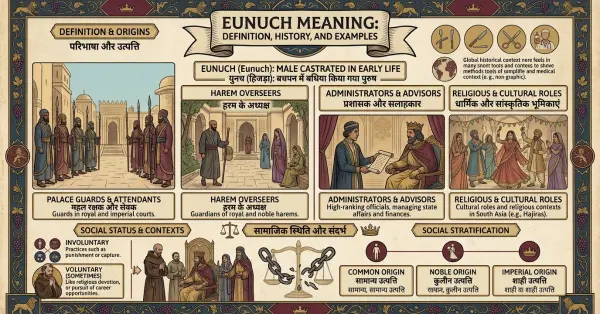
Some were:
- Palace servants
- Court officials
- Guards
- Administrators
- Advisors
- Household officials
- Religious figures
Their responsibilities varied greatly across different cultures.
Where Does the Word “Eunuch” Come From?
The English word eunuch comes through Latin and Greek.
It is commonly connected to the Greek word eunouchos, which was used for a eunuch or court official.
The word entered European languages through historical and religious writing and eventually became part of English.
Because eunuchs appear in ancient records and religious texts, the word has remained part of historical vocabulary for centuries.
Why Were Eunuchs Used in Royal Courts?
Eunuchs were employed in some royal and imperial courts for various reasons.
One historical reason was that rulers sometimes considered eunuchs suitable for positions involving close access to royal households.
In certain societies, eunuchs worked in areas where rulers wanted trusted officials or servants.
They could be responsible for:
- Managing palace affairs
- Supervising household workers
- Delivering messages
- Protecting certain areas
- Managing administrative tasks
- Serving members of royal families
However, practices differed significantly between cultures and time periods.
It would be inaccurate to assume that all eunuchs had the same status or responsibilities.
Eunuchs in Ancient History
Eunuchs appear in historical records from several regions.
They were known in parts of the:
- Ancient Near East
- Byzantine Empire
- Islamic world
- Chinese imperial courts
- South Asian kingdoms
In some periods, eunuchs could gain significant political or administrative influence.
In other situations, they had limited status and were treated primarily as servants.
Their experiences were therefore very different depending on the time, place, and political system.
Eunuchs in China
Eunuchs played a particularly important role in the history of imperial China.
For centuries, eunuchs served inside imperial palaces. Some worked closely with emperors and members of the imperial household.
Certain eunuchs eventually became powerful court officials.
One famous historical example is Zheng He, a Ming dynasty admiral who was a eunuch and led major maritime expeditions during the early 15th century.
However, the history of Chinese eunuchs was complex. Some became influential, while others faced difficult conditions and strict palace rules.
Eunuchs in South Asia
Eunuchs also appear throughout the history of South Asia.
They served in various royal courts, particularly during some periods of the Delhi Sultanate and Mughal Empire.
Some worked as:
- Palace officials
- Guards
- Administrators
- Advisors
- Household servants
Historical sources show that certain eunuchs could hold positions of considerable responsibility.
The history of gender and social roles in South Asia is complex, so the historical term eunuch should not automatically be treated as identical to every modern South Asian gender identity or community.
Eunuchs in Religious Texts
The word eunuch also appears in religious and historical texts.
For example, the Bible contains references to eunuchs in several passages.
The term can refer to people who were literally castrated, but some passages may use the word in broader ways depending on translation and historical interpretation.
Because translations differ, readers should consider the specific passage and translation rather than assuming that every reference has exactly the same meaning.
Is Eunuch an Offensive Word?
The word eunuch is generally a historical and descriptive term.
However, using it to describe a modern person can be sensitive or inappropriate unless the person identifies with or accepts the term.
It is usually safest to use eunuch when discussing historical figures, historical institutions, literature, or a person who explicitly uses that term for themselves.
Avoid using historical labels casually as insults.
Eunuch vs. Castrated Man
These terms are related but are not always identical in usage.
Castrated man describes the physical condition.
Eunuch is a historical and social term that has often referred to castrated men, particularly those who occupied specific social or official roles.
For example:
- Castrated man: focuses on the physical condition.
- Eunuch: often carries historical or social meaning.
The context determines which term is appropriate.
How to Use “Eunuch” in a Sentence
Here are some simple examples:
- The eunuch served in the emperor’s palace.
- Historical records mention eunuchs working as court officials.
- The king trusted the eunuch with important palace duties.
- The novel features a eunuch who serves the royal family.
- Eunuchs held different roles in different historical societies.
These examples use the word in historical contexts.
Eunuch Meaning in Modern English
In modern English, eunuch is not a common everyday word.
You are more likely to see it in:
- History books
- Religious studies
- Academic writing
- Historical novels
- Documentaries
- Museums
- Discussions of ancient societies
It is not normally used as casual everyday vocabulary.
If you encounter the word online, check the surrounding sentence because the writer may be discussing history, religion, literature, or a specific cultural tradition.
Common Misunderstandings About Eunuchs
One common misunderstanding is that all eunuchs had the same social role.
That is not true.
Different societies treated eunuchs differently. Some were servants, while others became administrators, military figures, advisors, or influential court officials.
Another misunderstanding is that the word describes a modern gender identity. Historically, eunuch primarily described a social and bodily status connected with castration. Modern gender identities and historical eunuch identities should not automatically be treated as the same thing.
Frequently Asked Questions
What is the simple meaning of eunuch?
A eunuch traditionally means a man who has been castrated, especially one who historically served in a royal court or official position.
Were eunuchs always servants?
No. Some eunuchs served as palace workers, but others became administrators, advisors, military figures, or influential court officials.
Where were eunuchs found?
Historical records mention eunuchs in several societies, including China, the Byzantine Empire, the Middle East, South Asia, and other regions.
Is eunuch a modern word?
The word still exists in English, but it is mainly used in historical, religious, academic, or literary contexts.
What is the difference between a eunuch and a castrated man?
“Castrated man” describes a physical condition, while “eunuch” is a historical and social term traditionally associated with castrated men.
Can eunuch refer to a woman?
Historically, the term eunuch specifically refers to a male or male-assigned person who was castrated. It should not generally be used as a synonym for woman.
Conclusion
The eunuch meaning is traditionally a castrated man, particularly one who served in a royal court, palace, or official position.
Eunuchs played different roles across history. Some served rulers and royal families, while others became administrators, advisors, guards, or powerful court officials.
The word appears in historical records, religious texts, literature, and academic discussions. Because its meaning is strongly connected to historical practices, it is most commonly understood in a historical context.
In simple terms:
Eunuch = a traditionally castrated man, often associated with historical royal or official service.