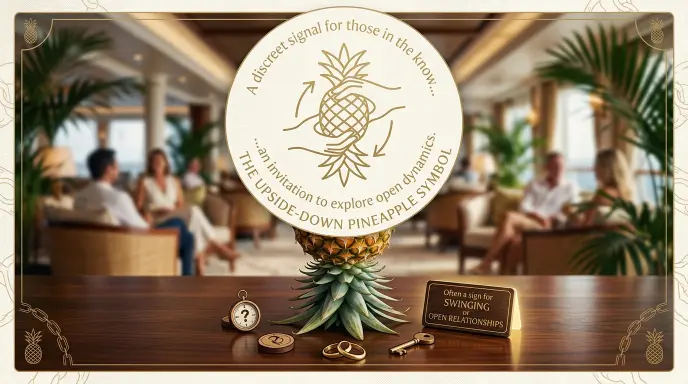
The upside down pineapple meaning can be confusing because a pineapple placed upside down may look like an ordinary decoration, but in some online and social settings, it can carry a hidden message. Many people search for this phrase after seeing an upside-down pineapple on clothing, social media profiles, decorations, stickers, or dating apps and wondering whether it has a special meaning.
The pineapple itself has long been connected with hospitality, friendship, warmth, and welcoming guests. However, its meaning can change when the fruit is intentionally shown upside down. In certain modern social contexts, particularly dating and lifestyle communities, it may be used as a discreet symbol connected with openness and non-traditional relationships.
That does not mean every upside-down pineapple has a secret message. Sometimes it is simply a design choice, a joke, a decoration, or an artistic image. Understanding the context is therefore important before making assumptions about what someone means.
Meaning & Definition
The upside down pineapple meaning depends heavily on where and how the symbol is being used. In traditional symbolism, a pineapple is usually associated with hospitality, friendship, generosity, and welcoming people. Turning it upside down can give the familiar symbol a different modern interpretation.
In some adult social and dating communities, an upside-down pineapple is commonly understood as a discreet sign associated with swinging or openness to non-traditional relationships. The symbol can be used to communicate interest without directly stating it. You may see it in profile pictures, clothing, jewelry, home decorations, or online posts.
However, this interpretation is not universal. There is no official rule saying that an upside-down pineapple always represents a particular lifestyle. Someone may use the image simply because they like pineapples, enjoy unusual designs, or think the symbol looks funny.
Context is the key. If the symbol appears on a dating profile alongside language about open relationships, alternative lifestyles, or meeting like-minded people, its intended meaning may be easier to understand. If it appears on a kitchen towel or party decoration, there may be nothing deeper behind it.
The safest definition is therefore: an upside-down pineapple can be a modern discreet symbol of openness in certain relationship and lifestyle communities, but it can also have completely ordinary meanings.
Background
The pineapple has a long history as a symbol of hospitality. Its unusual appearance, tropical origin, and historical value helped make it an attractive symbol for welcoming guests. In different cultures and periods, pineapples have appeared in architecture, artwork, table decorations, signs, and household objects.
The modern upside-down interpretation developed much later and is particularly associated with contemporary social and dating culture. Over time, symbols have become useful ways for people to communicate interests without writing a direct statement. An unusual fruit orientation can therefore become a subtle signal within a particular community.
The important point is that the upside-down pineapple does not have one universally accepted historical meaning. Its modern association with alternative relationship lifestyles is a cultural convention rather than a scientific definition or an official symbol.
The internet has also made the symbol much more recognizable. Social media, dating platforms, memes, videos, merchandise, and online discussions can spread symbolic meanings quickly. A person who has never heard of the association may suddenly encounter the symbol online and search for an explanation.
This is why the phrase can be confusing. Two people can look at exactly the same pineapple and understand it differently. One person may see a fun tropical design, while another may recognize the lifestyle reference.
Symbols also change over time. A meaning that is common in one online community may be completely unknown in another. Therefore, it is better to treat the upside-down pineapple as a context-dependent symbol rather than assuming that everyone using it has the same intention.
Usage in Different Contexts
The meaning of an upside-down pineapple can change depending on the setting. Context is especially important because the symbol can be used for innocent, humorous, decorative, or relationship-related reasons.
On social media, people may use the symbol as part of a joke, meme, profile description, or lifestyle reference. Someone familiar with the symbol may recognize the intended message immediately, while another viewer may simply see a pineapple.
In dating environments, the symbol can sometimes act as a subtle signal. People interested in alternative relationship arrangements may use it because it allows them to communicate a preference indirectly. It can be easier than writing a detailed explanation in a public profile.
In everyday life, however, an upside-down pineapple can mean nothing special. A restaurant may use it as decoration. A clothing brand may use it as a graphic. A person may place a pineapple upside down because they prefer the visual appearance.
In professional environments, the symbol generally does not have a standard business, academic, or workplace meaning. If you see one in an office, advertisement, presentation, or professional document, you should not automatically interpret it as a relationship signal.
This distinction matters because symbols can easily be misunderstood. A person should not be labeled or questioned about their private relationships simply because they happen to use a pineapple design.
When interpreting any unusual symbol, consider the surrounding words, platform, audience, and conversation. A symbol by itself rarely provides enough information to understand someone’s intentions accurately.
Meaning in Chat, WhatsApp, Instagram, and TikTok
The upside-down pineapple can occasionally appear in digital conversations and social media posts. Its meaning online is usually determined by the people involved and the context surrounding the image.
In chat and WhatsApp, someone might send an upside-down pineapple emoji-style image, sticker, GIF, or picture as an inside joke or subtle reference. If the conversation is about dating or relationships, the meaning may be more intentional. In a normal conversation about food, travel, or tropical themes, it may simply refer to pineapples.
On Instagram, the symbol can appear in usernames, bios, captions, profile pictures, clothing designs, or posts. Some users recognize it as a lifestyle reference, while others use it for aesthetics or humor.
On TikTok, the meaning can become even more complicated because trends and memes often give symbols temporary meanings. A creator may use an upside-down pineapple as part of a joke, viral trend, or discussion about dating culture.
It is also important to remember that social media meanings are not always fixed. One creator may use a symbol seriously while another uses it ironically. A viewer who knows one interpretation may assume that interpretation applies everywhere.
If you see the symbol in someone’s profile and are unsure what they mean, look at the surrounding information rather than relying on the pineapple alone. Their bio, captions, hashtags, or conversation may provide useful context.
Most importantly, do not treat the symbol as automatic proof of someone’s relationship preferences. Online symbols can be ambiguous, and personal communication is always more reliable than assumptions.
Meaning in Physics, Medical, and Aircraft Terminology
There is no widely recognized standard technical definition of an upside-down pineapple in physics, medicine, or aviation simply because the fruit is displayed upside down.
In physics, an upside-down pineapple is not a standard scientific symbol, unit, measurement, or established technical concept. A pineapple illustration might appear in an educational example or graphic, but its orientation does not create a recognized physics meaning.
In medical terminology, the phrase is also not a standard diagnosis, condition, treatment, anatomical term, or medical abbreviation. A medical article could theoretically use a pineapple image as an illustration, but an upside-down pineapple itself does not represent a recognized medical condition.
The same applies to aircraft and aviation terminology. Aviation uses many symbols, abbreviations, signs, and standardized markings, but an upside-down pineapple is not a generally accepted aviation term or universal aircraft signal.
This distinction is useful because people sometimes encounter an unfamiliar phrase and assume it must have a specialized technical definition. Search results and social media discussions can make ordinary symbols appear more complicated than they really are.
If the phrase appears in a technical document, it is better to examine the specific context. It could be a company logo, training illustration, diagram label, nickname, or unrelated graphic.
Therefore, if someone asks whether an upside-down pineapple has a special meaning in physics, medicine, or aircraft terminology, the simple answer is that it does not have a broadly standardized technical meaning in those fields.
Common Misconceptions
One of the biggest misconceptions is that every upside-down pineapple represents the same thing. That is not true. Symbolic meanings depend on culture, community, platform, and context.
Another misconception is that seeing an upside-down pineapple automatically tells you someone’s relationship status or sexual preferences. It does not. A person may use the image because they like tropical fruit, enjoy unusual artwork, or simply find the symbol amusing.
Some people also assume that the symbol has been an ancient universal code. While pineapples have a long history as symbols of hospitality, the modern lifestyle-related interpretation is a much more recent cultural association.
Another common mistake is treating online symbolism as a formal rule. Internet communities often develop informal signals, but those signals are not necessarily recognized everywhere.
People can also confuse the upside-down pineapple with unrelated symbols. Similar-looking images may be used for completely different reasons in fashion, branding, art, or memes.
The safest approach is to avoid jumping to conclusions. If the context clearly points toward a particular meaning, you can understand the reference accordingly. If the context is unclear, it is perfectly reasonable to treat the pineapple as simply a pineapple.
In personal situations, respectful communication is always better than making assumptions based on a symbol. A person’s words and stated preferences are more reliable than an image that can have several interpretations.
Similar Terms & Alternatives
Several phrases can appear alongside discussions about the upside-down pineapple, although they do not necessarily mean exactly the same thing.
Pineapple symbol is a broad term that can refer to the fruit as a general symbol of hospitality, warmth, friendship, or tropical culture. It does not automatically imply a relationship-related meaning.
Pineapple emoji usually refers to the 🍍 emoji. Its meaning can range from food and vacations to tropical themes, jokes, or personal symbolism. The emoji itself is not automatically a dating signal.
Swinging is a term commonly associated with consensual non-monogamous relationships in which partners may engage with other people. This is one of the relationship contexts sometimes connected with the upside-down pineapple.
Open relationship is a broader relationship term describing an agreed arrangement in which partners allow some form of romantic or sexual connection outside their primary relationship.
Non-monogamy is an umbrella term covering relationship structures that do not follow traditional exclusivity.
These terms should not be treated as perfect synonyms. An upside-down pineapple can be used as a discreet symbol, while the other terms directly describe relationship concepts.
The important difference is that a symbol is indirect. Words are usually much clearer. If someone explicitly says they are interested in an open relationship, there is little ambiguity. If someone simply posts an upside-down pineapple, several interpretations remain possible.
Understanding these distinctions helps prevent misunderstandings, especially in online conversations and dating environments.
How to Respond to It
How you should respond to an upside-down pineapple depends entirely on the situation.
If someone sends you the symbol casually, you can simply continue the conversation. You do not need to assume that they are communicating a hidden message.
If the conversation appears to involve dating or relationship preferences, you can ask politely what they mean. A simple question such as, “What does the pineapple mean to you?” can avoid unnecessary assumptions.
If someone uses the symbol in a public profile and you are considering contacting them, read their profile carefully first. Their written description may explain their intentions more clearly than the symbol.
If you are uncomfortable with a conversation that seems to move toward a topic you do not want to discuss, you can set a clear boundary. You are never required to participate in a conversation simply because someone uses a particular symbol.
It is also important to avoid teasing, judging, or publicly identifying someone based on the symbol. Relationship preferences are personal, and an ambiguous image should not be treated as evidence.
A respectful response is usually the best response. Ask when clarification is genuinely needed, listen to the answer, and avoid assuming that your interpretation is automatically correct.
Differences From Similar Words
The upside-down pineapple is different from ordinary pineapple references in several important ways.
A regular pineapple commonly represents hospitality, tropical living, food, friendship, or a decorative style. It can have many positive cultural associations without carrying any relationship-related message.
An upside-down pineapple, in contrast, has developed an additional informal association in certain adult and dating communities. However, that association is not universal.
A pineapple emoji 🍍 is also not automatically equivalent to an upside-down pineapple. The standard emoji normally appears upright, so its ordinary meaning is usually based on the fruit itself rather than its orientation.
Similarly, terms such as open relationship, swinging, and non-monogamy describe relationship concepts directly. An upside-down pineapple is only an indirect symbol that may point toward one of those ideas.
This distinction matters because people sometimes assume that every pineapple reference has the same meaning. It does not.
Think of it this way: the word or symbol provides a clue, while the context provides the explanation. Without context, even a commonly recognized symbol can be misunderstood.
When discussing relationships, direct communication is always more accurate than relying on symbols. If the subject matters, it is better to ask or explain rather than guess.
Relevance in Online Conversations & Dating Apps
The upside-down pineapple has become particularly interesting in online dating because dating platforms encourage people to communicate personal interests quickly. A symbol can sometimes function as a shorthand for an idea that would otherwise require several sentences.
Some users may recognize the pineapple as a reference to alternative relationship lifestyles. Others may have no idea what it means. This difference in knowledge can create confusion between people who see the same profile.
On dating apps, context is especially important. If the symbol appears next to descriptions involving open relationships, ethical non-monogamy, or swinging, the intended meaning is easier to understand. If it appears alone, it could simply be an aesthetic choice.
People should also remember that dating profiles are personal. A symbol does not give permission to make inappropriate assumptions or immediately ask invasive questions. Respectful conversation still matters.
If you are interested in someone and notice an upside-down pineapple, the best approach is to focus on the person’s actual profile and communication. If the topic becomes relevant, you can ask a polite, non-judgmental question.
The symbol can be useful as a discreet reference, but it is not a universal language. Different people may understand it differently, and trends can change as online communities evolve.
Ultimately, the most reliable way to understand someone’s intentions is through clear and consensual communication rather than decoding a single image.
FAQs
1. What does an upside-down pineapple mean?
An upside-down pineapple can have several meanings. In some modern dating and lifestyle communities, it is associated with swinging or openness to non-traditional relationships. However, it can also simply be a decorative or humorous image.
2. Does an upside-down pineapple always mean swinging?
No. The symbol is not a universal code. While it is sometimes associated with swinging, you should consider the surrounding context before assuming that someone is using it with that meaning.
3. What does an upside-down pineapple mean on dating apps?
On dating apps, it may be used as a discreet signal that someone is familiar with or interested in alternative relationship lifestyles. However, users may also include it simply as a design element or joke, so the profile’s overall context matters.
4. Does the pineapple emoji 🍍 have the same meaning?
Not necessarily. The ordinary pineapple emoji can represent fruit, food, tropical places, vacations, hospitality, or humor. Its meaning depends on the conversation. The upside-down version has a more specific informal association in some communities.
Conclusion
The upside down pineapple meaning is more complicated than it first appears. Pineapples have traditionally represented hospitality, warmth, friendship, and welcoming guests. In modern online and dating culture, however, an upside-down pineapple can sometimes be used as a discreet reference to swinging or other non-traditional relationship lifestyles.
Still, the symbol should never be treated as automatic proof of someone’s preferences. People use pineapple images for many reasons, including decoration, humor, fashion, food, travel, and personal style. The same symbol can therefore have completely different meanings in different situations.
Context is the most important clue. Look at the surrounding conversation, profile information, or message before reaching a conclusion. When the meaning matters, respectful communication is always better than guessing. A symbol can suggest an idea, but only the person using it can explain exactly what they intended.

James Baldwin was a fearless American writer and activist, exploring race, identity, and justice with sharp honesty. Read inspiring literary bios on punsora.com for readers seeking truth, courage, and insight.