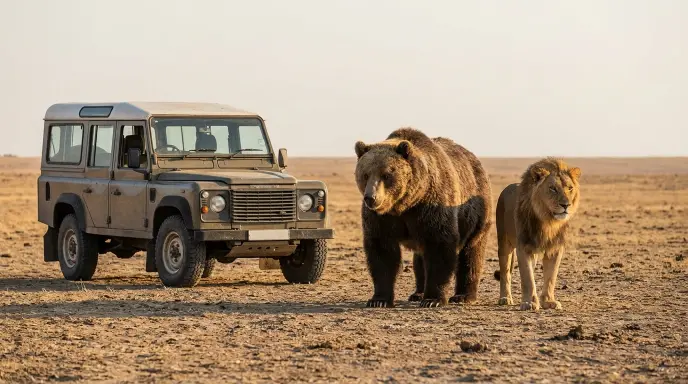
A large brown, grizzly, or polar bear is generally much heavier and more powerful than an adult male lion, while lions have advantages in agility, speed, and specialized hunting technique. However, “bear” includes many species, so a bear vs lion comparison depends heavily on which bear is being considered. A real fight between the two is hypothetical because their modern ranges largely do not overlap.
Key Takeaways
- Large brown and polar bears can weigh substantially more than adult male lions.
- Lions are more specialized for active predation and have strong jaws, claws, speed, and agility.
- Brown bears can weigh anywhere from about 200 to 1,000 pounds depending on sex, location, and season.
- Male lions generally weigh about 330 to 550 pounds, according to the Smithsonian’s National Zoo.
- A hypothetical encounter has no guaranteed outcome because species, individual size, terrain, health, and behavior would all matter.
Bear vs Lion: Quick Comparison
FeatureBearLionAnimal familyUrsidaeFelidaeTypical body typeHeavy, powerful, compactAthletic, muscular, flexibleDietVaries by species; many are omnivorousPrimarily carnivorousMain advantageMass and physical power in large speciesAgility and predatory specializationClawsNon-retractableRetractableSocial behaviorOften solitary, depending on speciesHighly socialHunting styleVaries considerablyStalking, chasing, ambushing and cooperative huntingHabitatForests, mountains, Arctic, and other environmentsMainly African grasslands, savannas and other habitatsTypical comparisonLarge bears can greatly exceed lion massLarge male lions are powerful but generally lighter than the largest bears
The biggest mistake in a bear vs lion comparison is treating every bear as the same size. A polar bear or large brown bear is a very different opponent from a sun bear or other smaller bear species.
How Big Is a Bear Compared With a Lion?
Size is one of the clearest differences between the animals, but the answer depends on the bear species.
The U.S. National Park Service says brown bears range from about 200 to 1,000 pounds, with size influenced by sex, location, and season. Very large brown bears can also approach 9 feet when standing on their hind legs.
Katmai National Park provides an even more specific example. Adult male brown bears there commonly weigh around 600–900 pounds during mid-summer, and large males can exceed 1,000 pounds in autumn.
By comparison, the Smithsonian’s National Zoo lists adult male lions at approximately 330–550 pounds, with males reaching around 10 feet in total length including the tail.
This means a large brown bear can be considerably heavier than a male lion.
Brown and Grizzly Bears
“Brown bear” and “grizzly bear” refer to the same species, Ursus arctos, although the terms are commonly used for different populations and geographic settings in North America. The National Park Service notes that coastal brown bears are generally larger because of differences in food availability and habitat.
A Yellowstone grizzly is therefore not necessarily the same size as a very large Alaskan brown bear.
Black Bears and Other Smaller Bears
Not every bear is larger than a lion.
American black bears can be considerably smaller than large brown bears. The National Park Service notes that male black bears can weigh roughly 125–500 pounds depending on conditions and food availability.
That creates an important distinction: “bear vs lion” is not automatically a comparison between a huge bear and a lion.
Bear vs Lion: Strength and Physical Power
Large bears are built for tremendous physical power. Brown bears have a distinctive shoulder hump made largely of muscle. The National Park Service explains that this muscle helps them generate force while digging for food.
Their body structure is also different from that of a big cat. Brown bears have heavy forequarters, broad bodies, strong limbs, and long claws. The U.S. Fish and Wildlife Service describes brown bears as plantigrade animals with a large muscular shoulder hump.
Lions are also extremely powerful. The Smithsonian describes them as having strong, compact bodies, powerful forelegs, teeth, and jaws used to pull down and kill prey.
In a simple physical comparison, a very large brown or polar bear has the advantage in body mass and overall bulk, while the lion has a lighter, more flexible body designed for predatory movement.
Speed and Agility
Speed is one area where the lion’s body design becomes important.
Lions have a flexible, athletic build suited to stalking and short bursts of pursuit. They can rapidly change direction and use their forelegs and claws while grappling with prey.
Bears should not be thought of as slow simply because they are heavy. Yellowstone National Park lists grizzly bears at approximately 35–40 mph.
This makes the common idea that a lion can simply outrun any bear misleading.
The more meaningful difference is agility and movement style. Lions are specialized big-cat predators that use stalking, acceleration, grappling, and coordinated hunting. Bears are built more around strength, stability, digging, foraging, and endurance.
Claws, Teeth, and Bite
Both animals possess formidable natural weapons, but they use them differently.
Brown bears have long front claws. The National Park Service notes that brown bear front claws can measure roughly 2–4 inches depending on the individual and its digging behavior.
Lion claws are retractable, allowing the cat to keep them sharp and use them during hunting. Lions also have large canine teeth and powerful jaws designed for subduing prey.
A lion’s weapons are therefore closely connected to its predatory lifestyle. A bear’s claws and jaws are part of a broader toolkit used for feeding, digging, defense, and predation.
Hunting Style and Behavior
How Lions Hunt
Lions are highly social cats. The Smithsonian calls them the world’s most social felines, noting that they hunt cooperatively and raise cubs within prides.
Female lions are particularly important hunters, although males also participate in hunting and territorial defense.
Their hunting strategy can involve stalking prey, approaching within striking distance, accelerating quickly, and using their forelegs and jaws to bring prey under control.
How Bears Find and Capture Food
Bears have a much broader feeding strategy.
Brown bears are omnivores and may eat plants, berries, fish, small mammals, carrion, and other foods depending on location and season.
Their powerful shoulders and claws are especially useful for digging and obtaining food. Some populations also become highly skilled at catching fish.
This means comparing the two simply as “predators” misses an important biological difference: lions are specialized carnivorous hunters, while many bears are adaptable omnivores.
Bear vs Lion: Who Would Win?
The “who would win” question is hypothetical rather than a predictable wildlife outcome.
If the comparison is specifically a large adult brown or grizzly bear versus a single adult male lion, the bear’s greater potential body mass and heavy build would give it a substantial physical advantage in a direct confrontation.
That does not mean a lion lacks effective defenses or offensive abilities. Lions are highly capable predators with powerful jaws, claws, athletic movement, and extensive experience handling large prey.
Terrain would also matter. Open ground could allow the lion to use movement and positioning, while close quarters could reduce the usefulness of agility and increase the importance of body mass and strength.
Most importantly, wild animals do not follow a fixed “battle script.” Age, sex, individual size, health, injuries, motivation, surprise, and escape opportunities could all affect an encounter.
Grizzly Bear vs Lion
A large grizzly or brown bear can weigh considerably more than a male lion. Yellowstone’s average adult male grizzly is listed at 413 pounds, with the heaviest known male in the Greater Yellowstone Ecosystem recorded at 715 pounds.
That difference in mass would be an important factor in a hypothetical one-on-one confrontation.
Polar Bear vs Lion
A polar bear is another special case. Polar bears are among the largest living bear species, so a comparison with a lion involves an especially large difference in body size.
However, polar bears and African lions live in radically different environments. Polar bears are adapted to Arctic conditions, while African lions primarily inhabit African grasslands, savannas, and related habitats.
Therefore, a polar bear vs lion matchup is best understood as a hypothetical comparison of anatomy rather than a realistic natural encounter.
Smaller Bear vs Lion
The answer becomes less straightforward when the bear is a smaller species.
Some bears can weigh less than a large male lion. In such a comparison, the lion’s combination of agility, claws, jaws, and specialized predatory behavior becomes much more significant.
That is why a scientifically careful answer should never simply say “bear” without identifying the species.
Why the Answer Depends on the Species
The phrase bear vs lion sounds like a simple matchup, but it actually combines multiple possible comparisons.
A large brown bear, a Yellowstone grizzly, an American black bear, and a polar bear differ substantially in size and anatomy. The same is true when comparing male and female lions.
For example:
- A large Alaskan brown bear can exceed 1,000 pounds.
- A Yellowstone male grizzly averages about 413 pounds.
- Male lions generally weigh about 330–550 pounds.
- Male black bears can range from roughly 125 to 500 pounds.
So there is no single body-size answer that applies to every bear.
Frequently Asked Questions
Is a bear stronger than a lion?
A large brown or polar bear generally has greater absolute body mass and heavy-body strength than a lion. Lions, however, have powerful forelegs, jaws, claws, and a body specialized for hunting large prey. Strength therefore depends partly on which bear species and individual are being compared.
Is a bear bigger than a lion?
Large brown and polar bears can be much heavier than lions. The National Park Service reports brown bears ranging from about 200 to 1,000 pounds, while the Smithsonian lists adult male lions at approximately 330–550 pounds. Smaller bear species can overlap with or fall below the size of a large lion.
Can a lion beat a grizzly bear?
A lion could potentially injure a bear, but there is no reliable way to predict the result of a hypothetical fight. A large grizzly has a substantial body-mass and physical-strength advantage, while the lion has agility and specialized predatory abilities. The individual animals and circumstances would matter.
What is faster, a bear or a lion?
Neither animal can be assigned one universal speed because speed varies by species and individual. Yellowstone National Park lists grizzlies at about 35–40 mph. Lions are also capable of high-speed short bursts, but their major advantage is not simply top speed; it is their overall combination of agility and predatory movement.
Would a polar bear beat a lion?
A polar bear is substantially larger and heavier than an adult male lion, so the physical comparison strongly favors the bear’s size and mass. But an actual fight is hypothetical because polar bears and lions have completely different natural ranges and environments.
Final Verdict
The bear vs lion comparison is most useful when it focuses on biology rather than treating the matchup as a guaranteed fight.
Large bears especially brown and polar bears can have a major advantage in body mass, heavy musculature, and physical power. Lions counter that with agility, claws, powerful jaws, and highly specialized hunting behavior.
The most important detail is the species. A large brown bear versus a male African lion is a very different comparison from a smaller bear versus a lion. There is no universal outcome for every possible bear and lion matchup.
For wildlife enthusiasts, the more interesting lesson is that both animals evolved different solutions to survival: bears emphasize adaptable feeding and powerful bodies, while lions are specialized social predators built around hunting and cooperation.

James Baldwin was a fearless American writer and activist, exploring race, identity, and justice with sharp honesty. Read inspiring literary bios on punsora.com for readers seeking truth, courage, and insight.