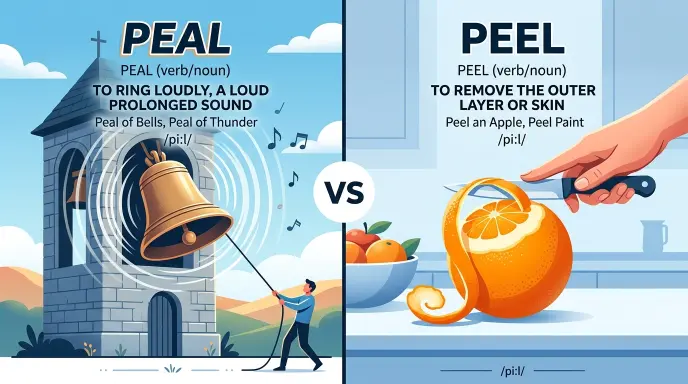
Peal and peel are homophones, meaning they sound the same but have different spellings and meanings. “Peal” refers to a loud or ringing sound, especially from bells, thunder, or laughter. “Peel” refers to the outer skin or covering of something or the act of removing it, such as peeling an orange or peeling paint.
Key Takeaways
- Peal relates to a loud, ringing, or prolonged sound.
- Peel refers to an outer skin, covering, or the act of removing it.
- Both words are pronounced the same: /piːl/ in American English.
- Both peal and peel can be used as nouns and verbs.
- Think peal = sound and peel = outer layer.
What Is the Difference Between Peal and Peel?
The main difference between peal and peel is their meaning and spelling.
Although they sound exactly alike, they are used in completely different situations. Peal is associated with sound, particularly a loud or ringing sound. For example, you might hear a peal of thunder, a peal of bells, or peals of laughter.
Peel, on the other hand, is connected with an outer layer. It can mean the skin of a fruit or vegetable, or it can describe the action of removing a covering. You can peel a banana, remove an orange peel, or watch paint peel from a wall.
The easiest way to choose between them is to look at the context:
Sound → peal Outer layer or removing a layer → peel
Peal: Meaning and Uses
Peal can be used as both a noun and a verb.
As a noun, peal means a loud sound or a series of loud sounds. It is commonly used for bells, thunder, and laughter.
Examples:
- A peal of thunder woke me up.
- We heard the peal of church bells.
- Her joke produced peals of laughter.
As a verb, peal means to make or produce a loud, ringing sound.
Examples:
- The church bells pealed across the town.
- The bells began to peal at noon.
- Laughter pealed through the room.
Cambridge Dictionary defines peal as a verb meaning to sound loudly and as a noun referring to a loud sound, including a long loud sound or series of sounds.
Peel: Meaning and Uses
Peel can also work as both a noun and a verb, but its meaning is completely different from peal.
As a noun, peel means the outer skin of a fruit or vegetable, especially after it has been removed.
Examples:
- Put the banana peel in the compost.
- Lemon peel adds flavor to the dessert.
- The potato peel was left on the counter.
As a verb, peel means to remove the skin or outer covering of something.
Examples:
- Please peel the apples.
- She peeled the potatoes before cooking.
- He peeled the orange carefully.
The word can also describe a covering coming away from a surface. For example, paint can peel, wallpaper can peel, and a label can be peeled off.
Peal vs Peel: Side-by-Side Comparison
WordMain MeaningCommon ContextsExamplePealA loud or ringing soundBells, thunder, laughterA peal of thunder shook the house.PealTo make a loud soundBells or other soundsThe bells pealed loudly.PeelOuter skin or coveringFruits, vegetables, surfacesThe orange peel was thick.PeelTo remove an outer layerFood, paint, wallpaperPlease peel the potatoes.
Both words can be nouns or verbs, so their grammatical role alone does not tell you which spelling to use. Meaning and context are what matter.
How to Use “Peal” in a Sentence
Peal as a Noun
Use peal as a noun when you are talking about a loud, ringing, or prolonged sound.
Correct examples:
- We heard a peal of thunder during the storm.
- A peal of bells announced the celebration.
- The room filled with peals of laughter.
- The sudden peal of laughter surprised everyone.
One especially common phrase is “peals of laughter.” The word peal works because laughter is being described as a loud, ringing or repeated sound.
Peal as a Verb
Use peal as a verb when something produces a loud or ringing sound.
Examples:
- The bells pealed throughout the morning.
- Church bells pealed in the distance.
- The alarm pealed loudly through the building.
In ordinary writing, peal is most strongly associated with bells and loud, sustained sounds.
How to Use “Peel” in a Sentence
Peel as a Noun
Use peel as a noun when referring to the skin or outer layer of something.
Examples:
- The peel of the orange was easy to remove.
- Don’t throw away the lemon peel yet.
- Potato peel can be used in several recipes.
Although fruit and vegetables are common contexts, peel can refer more broadly to an outer covering.
Peel as a Verb
Use peel as a verb when someone or something removes an outer layer.
Examples:
- Can you peel the carrots?
- She peeled the apple.
- We need to peel the potatoes before cooking.
It can also describe a covering that comes away:
- The old paint began to peel.
- The wallpaper is peeling from the wall.
- Peel the backing strip off the label.
Cambridge lists these food, covering, and body-related uses of peel, showing that the word extends beyond fruit and vegetables.
Peal vs Peel: Common Mistakes
Because these words sound identical, mistakes usually happen in writing rather than speech.
Here are some common errors:
Incorrect: The peel of thunder frightened the children. Correct: The peal of thunder frightened the children.
Incorrect: Remove the peal from the orange. Correct: Remove the peel from the orange.
Incorrect: We heard a peel of church bells. Correct: We heard a peal of church bells.
Incorrect: Please peal the potatoes. Correct: Please peel the potatoes.
A useful question can prevent nearly every mistake:
Am I talking about a sound or an outer layer?
If it is a sound, choose peal. If it involves skin, a covering, or removing a layer, choose peel.
Pealing vs Peeling
The same spelling difference appears in their -ing forms.
- Pealing = producing a loud or ringing sound
- Peeling = removing or coming away from an outer layer
Examples:
- The bells were pealing across the valley.
- The children were peeling oranges.
- We could hear the pealing of bells.
- The old paint was peeling from the door.
Cambridge identifies pealing as the present participle of peal and peeling as the present participle of peel.
Easy Ways to Remember Peal vs Peel
The simplest memory trick is:
Peal = Sound
Think of peal when you hear:
- Bells
- Thunder
- Laughter
- A loud ringing sound
For example:
A peal of thunder
Peel = Skin
Think of peel when you see:
- Bananas
- Oranges
- Apples
- Potatoes
- Paint
- Wallpaper
For example:
Peel an orange
Another useful trick is to connect peal with a bell. A bell produces a peal, while an orange has a peel.
You can also remember the basic contrast as:
Peal is heard. Peel is removed.
This is not a rule for every possible figurative use, but it is a practical shortcut for everyday writing.
Frequently Asked Questions
Is it peal or peel?
Both peal and peel are correct words, but they have different meanings. Use peal for a loud or ringing sound, such as a peal of thunder. Use peel for an outer layer or the act of removing it, such as orange peel or peel the potatoes.
Are peal and peel homophones?
Yes. Peal and peel are homophones because they have the same pronunciation but different spellings and meanings. In American English, both are pronounced /piːl/. Their identical pronunciation is why context is important when choosing the spelling in writing.
Is it a peal of laughter or a peel of laughter?
The correct expression is “a peal of laughter” or “peals of laughter.” Here, peal refers to a loud or ringing sound. For example: The comedian’s joke was followed by peals of laughter.
Is it a peal of thunder or a peel of thunder?
The correct expression is “a peal of thunder.” Thunder produces a loud sound, so the word peal is appropriate. For example: A sudden peal of thunder woke the baby.
Is orange peel correct?
Yes. Orange peel is the correct spelling because peel refers to the outer skin of an orange. For example: The recipe calls for grated orange peel.
Conclusion
The difference between peal vs peel is simple once you connect each spelling with its meaning.
Peal relates to a loud or ringing sound, especially the sound of bells, thunder, or laughter. Peel refers to an outer layer or the process of removing that layer. Both words are pronounced the same, which makes them easy to confuse when writing.
When you’re unsure, remember:
Peal = sound. Peel = skin or outer layer.
So you hear a peal of thunder, hear peals of laughter, peel an orange, and remove the peel from a banana.

John Updike was an American novelist, poet, and critic, famed for Rabbit series, suburban insight, elegant prose, literary awards, and lasting influence on modern fiction, cultural social psychological realism punsora.com