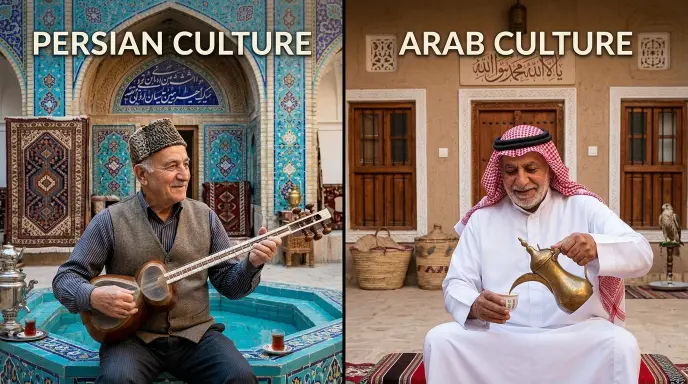
Persian and Arab are distinct ethnic and cultural identities with different historical and linguistic roots. Persians are primarily associated with Iran and speak Persian, an Indo-Iranian language. Arabs are associated with the Arabic-speaking world across the Middle East and North Africa and speak Arabic, a Semitic language. Iran is not an Arab country, although Arab communities live within Iran.
Key Takeaways
- Persian and Arab are not interchangeable identities.
- Persian is an Indo-Iranian language, while Arabic is a Semitic language.
- Iran is a multicultural country and is not part of the Arab world.
- Not every Iranian is ethnically Persian, and not every Arab lives on the Arabian Peninsula.
- Persian and Arab cultures have influenced each other for centuries, particularly through history, trade, religion, literature, and language.
What Is the Difference Between Persian and Arab?
The simplest way to understand Persian vs Arab is to separate four concepts: ethnicity, nationality, language, and religion.
Persian generally refers to an Iranian ethnic and cultural group associated particularly with Iran and the Persian language. Britannica describes Persians as the predominant ethnic group of Iran and identifies Persian as an Indo-Iranian language within the Indo-European family.
Arab, by contrast, refers to a broad ethnolinguistic and cultural identity associated with Arabic-speaking peoples across a large region extending through parts of the Middle East and North Africa. Britannica notes that modern usage encompasses Arabic-speaking peoples across a wide geographic area rather than a single country.
That means someone can be Iranian without being Persian, just as someone can be Arab without being from Saudi Arabia.
Persian Identity
Persian identity has deep roots in the history of Iran, historically known in the West as Persia. Persian culture developed through successive civilizations and dynasties and is strongly associated with the Persian language, literature, art, architecture, and traditions.
Persian is also used in a broader linguistic sense. Closely related varieties of Persian include Dari in Afghanistan and Tajik in Tajikistan.
Arab Identity
Arab identity is much broader geographically. The Arab world includes countries in both Western Asia and North Africa, and the Arab League currently has 22 member states.
Arab populations are culturally diverse. An Arab from Morocco, for example, may have different local traditions from an Arab from Iraq or Oman. Shared Arabic language and cultural heritage provide important connections, but Arab societies are not identical.
Persian vs Arab at a Glance
| Category | Persian | Arab |
|---|---|---|
| Main geographic association | Iran and the wider Persian cultural sphere | Middle East and North Africa |
| Identity | Ethnic/cultural and linguistic | Ethnolinguistic and cultural |
| Main language | Persian (Farsi) | Arabic |
| Language family | Indo-European → Indo-Iranian | Afro-Asiatic → Semitic |
| Writing direction | Right to left | Right to left |
| Common geographic misconception | All Iranians are Persian | All Arabs are from Arabia |
| Religion | Not defined by one religion | Not defined by one religion |
The most important distinction is that Persian and Arab do not describe the same ethnic or linguistic group.
Persian vs Arabic: The Language Difference
One of the biggest sources of confusion is the similarity between written Persian and Arabic.
Persian and Arabic are different languages from different language families. Persian belongs to the Indo-European family, specifically the Indo-Iranian branch. Arabic belongs to the Semitic branch of the Afro-Asiatic family.
Persian
Persian, commonly called Farsi in Iran, is the official language of Iran. Article 15 of Iran’s constitution identifies Persian as the country’s official language and script while permitting the use of regional and tribal languages in specified contexts.
Persian is also spoken in forms such as Dari and Tajik outside Iran.
Arabic
Arabic is a Semitic language with numerous regional varieties. Modern Standard Arabic is used in formal settings across the Arabic-speaking world, while everyday speech differs substantially from one country or region to another.
Arabic is used across a broad geographic area that includes North Africa, the Levant, Iraq, the Arabian Peninsula, and other parts of the Arab world.
Why Do Persian and Arabic Look Similar?
Persian adopted a modified form of the Arabic script after the Islamic conquest of Persia. As a result, written Persian can look familiar to someone who reads Arabic.
However, similar writing does not mean identical language.
Persian uses several letters that distinguish it from Arabic, and its pronunciation, grammar, sentence structure, and core vocabulary are different. Persian has also borrowed many Arabic words over the centuries, particularly in religious, scholarly, and literary contexts.
For example, Persian can contain vocabulary of Arabic origin while still remaining a separate Indo-Iranian language.
Is Iran an Arab Country?
No. Iran is not an Arab country.
Iran is a country with its own national identity and a diverse population. Its ethnic groups include Persians, Azeris, Kurds, Lurs, Baloch, Arabs, Turkmen, and others, while Persian is the official language.
This is why it is useful to distinguish Iranian from Persian.
“Iranian” generally describes nationality or citizenship. “Persian” can describe a particular ethnic identity and the Persian language.
So these statements are not equivalent:
- Iranian = Persian
- Iranian = Arab
- Persian = Arab
An Iranian citizen may be Persian, Azeri, Kurdish, Arab, Baloch, or part of another community.
Arabs in Iran
There are also Arab communities inside Iran, particularly in southwestern areas such as Khuzestan and regions around the Persian Gulf. Encyclopaedia Iranica documents Arabic-speaking communities in several parts of Iran.
Therefore, saying “Iran is not an Arab country” does not mean that “there are no Arabs in Iran.” Both facts can be true at the same time.
Persian and Arab History and Culture
Persian and Arab civilizations have interacted for centuries, so their histories cannot be understood as completely separate.
Persian Heritage
Persian history includes major pre-Islamic civilizations and empires, including the Achaemenian Empire. Persian literature later became one of the region’s major literary traditions, with influential poets and writers shaping cultural life across a much wider area than modern Iran.
Traditions such as Nowruz, Persian poetry, Persian architecture, and distinctive culinary traditions remain important parts of Persian cultural heritage.
Arab Heritage
Arab civilization has its own long history, including ancient societies of the Arabian Peninsula and the development of major intellectual, literary, scientific, and political centers across the Middle East and North Africa.
The spread of Islam also helped Arabic become a major language of religion, scholarship, administration, and literature across a vast geographic area.
Shared Influences
The differences between Persian and Arab identities should not be confused with complete separation.
Persian and Arabic cultures have influenced one another through trade, migration, scholarship, religion, politics, and literature. Persian contains many Arabic loanwords, while Persian culture and political traditions also influenced parts of the wider Islamic world.
The result is a region with substantial cultural overlap alongside clearly distinct identities.
Religion Does Not Define the Difference
Another common mistake is assuming that Persian means Muslim or Arab means Muslim.
Religion and ethnicity are different categories.
Many Persians are Muslim, and Islam has played a major role in Persian history and culture. However, Persian identity itself is not a religion.
Likewise, Arab identity is not synonymous with Islam. Arab communities include Muslims as well as Christians and people belonging to other religious or nonreligious backgrounds. A person’s religion alone cannot determine whether that person is Persian or Arab.
This distinction is especially important when discussing people in the United States, where national, ethnic, linguistic, and religious identities may overlap in many different ways.
Common Misconceptions About Persians and Arabs
“Persians are Arabs.”
No. Persian and Arab identities have different historical and linguistic origins.
“Everyone from Iran is Persian.”
Not necessarily. Iran contains several ethnic and linguistic communities.
“Persian is a type of Arabic.”
No. Persian and Arabic belong to different language families.
“Persians don’t have Arabic influence.”
They do. Persian has incorporated substantial Arabic vocabulary and has been deeply influenced by the history of Islam.
“All Arabs are from Saudi Arabia.”
No. Arab communities live across a large region covering much of the Middle East and North Africa.
“Iran and the Arab countries have the same culture.”
They share some regional and historical influences, but Iran has its own Persian and Iranian cultural traditions alongside its diverse ethnic communities.
Frequently Asked Questions
Are Persians Arab?
No. Persians and Arabs are distinct ethnic and cultural identities. Persians are particularly associated with Iran and the Persian language, while Arab identity is associated with Arabic-speaking peoples across the Middle East and North Africa. There are historical and cultural connections between the two, but Persian and Arab are not interchangeable terms.
Do Persians speak Arabic?
Persians primarily speak Persian, or Farsi in the Iranian context. Arabic is important in Iran because of its religious and historical role, and some Iranian communities speak Arabic as a native language. However, Persian itself is not Arabic. Iran’s constitution identifies Persian as the country’s official language.
Is Persian an Arabic language?
No. Persian is an Indo-Iranian language within the Indo-European family, while Arabic is a Semitic language within the Afro-Asiatic family. Persian uses a modified Arabic-derived script, which explains some of their visual similarity, but their grammatical structures and linguistic histories are different.
Are all Iranians Persian?
No. “Iranian” is a national identity, while “Persian” can refer to an ethnic and linguistic identity. Iran is home to several ethnic groups, including Persians, Azeris, Kurds, Lurs, Baloch, Arabs, and others.
Is Iran part of the Arab world?
Iran is geographically located in the Middle East but is not an Arab country. Persian is its official language, and its largest ethnic and cultural traditions are distinct from the Arab world. At the same time, Iran has Arab communities and long-standing historical relationships with neighboring Arab societies.
Conclusion
The easiest way to remember the Persian vs Arab distinction is to focus on identity, language, and history.
Persians are primarily associated with Iran and Persian culture, while Arabs belong to a broad ethnolinguistic community spread across the Middle East and North Africa. Persian and Arabic are also fundamentally different languages: Persian is Indo-Iranian, whereas Arabic is Semitic.
At the same time, the two cultures have never existed in complete isolation. Centuries of interaction have produced significant shared vocabulary, religious traditions, artistic influences, and historical connections.
Understanding these distinctions makes it easier to discuss Iran, the Arab world, Persian culture, and Middle Eastern history without treating a highly diverse region as culturally uniform.