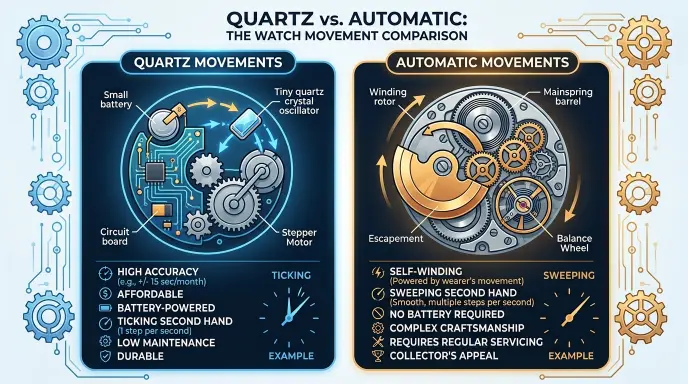
When comparing quartz vs automatic watches, quartz movements are generally more accurate, convenient, and low-maintenance, while automatic movements offer traditional mechanical construction and self-winding operation. Quartz watches use electronic timekeeping regulated by a quartz crystal, whereas automatic watches use a mechanical movement wound by a rotor as you wear the watch. The better choice depends on your priorities.
Key Takeaways
- Quartz watches prioritize accuracy, convenience, and low maintenance.
- Automatic watches use mechanical movements and wind themselves through wrist motion.
- Quartz generally keeps time more precisely than a typical automatic movement.
- Automatic watches do not need a battery, but they can stop after being left unworn.
- Your lifestyle, budget, and interest in mechanical watchmaking matter more than choosing a universally “better” movement.
What Is a Quartz Watch?
A quartz watch is a timepiece that uses an electronic movement regulated by a quartz crystal. A battery or another electrical power source supplies energy to the movement, while the quartz oscillator provides a highly consistent reference for measuring time.
This technology became a major shift in watchmaking because it allowed manufacturers to produce watches that were highly accurate, dependable, and relatively inexpensive to operate.
Quartz watches are especially popular with people who want a watch that can be put on and used without much thought. They are also available in a huge range of designs, from inexpensive everyday watches to high-end timepieces.
How Quartz Works
Inside a traditional quartz watch, electrical energy is used to make a tiny quartz crystal oscillate at a precise frequency. Electronic circuitry counts those oscillations and converts them into regular pulses that drive the watch.
The result is very consistent timekeeping.
Not every quartz watch is powered in exactly the same way, either. Standard quartz models commonly use replaceable batteries, while some watches use solar or light-powered quartz technology. For example, Citizen’s Eco-Drive watches use light as their energy source, showing that “quartz” does not automatically mean “replace the battery every few years.”
Advantages of Quartz Watches
Quartz watches are attractive when you value:
- High accuracy
- Low maintenance
- Simple operation
- Affordable ownership
- Lightweight construction in many models
- Reliable timekeeping
- Convenience when a watch is worn only occasionally
For someone who simply wants a dependable timekeeping tool, quartz can be an easy choice.
What Is an Automatic Watch?
An automatic watch is a mechanical watch that winds itself. Instead of relying on a battery, it uses a mainspring to store energy.
As the wearer moves their wrist, a weighted rotor moves inside the watch. That motion winds the mainspring, which then releases energy through the mechanical movement to power the watch.
This distinction is important: an automatic watch is not a completely separate category from mechanical watches. It is a type of mechanical watch. The key difference is how the mainspring is wound.
How Automatic Watches Work
An automatic movement contains many mechanical components working together, including gears, springs, a rotor, an escapement, and a balance wheel.
The rotor responds to movement from your wrist and winds the mainspring. The stored energy is then gradually released to keep the watch running.
Because the movement is mechanical, it does not require a conventional battery.
Many automatic watches also have a manual-winding function, allowing the wearer to wind the movement with the crown when necessary.
Advantages of Automatic Watches
Automatic watches appeal to people who value:
- Mechanical craftsmanship
- Traditional watchmaking
- A self-winding movement
- The experience of owning a mechanical timepiece
- A visible or interesting movement
- A smooth-moving seconds hand on many models
- The ability to maintain and service the mechanical movement over time
The attraction is not purely about accuracy. For many watch enthusiasts, the mechanism itself is part of the reason to own the watch.
Quartz vs Automatic: Key Differences
The biggest differences appear in accuracy, power, maintenance, price, and the overall ownership experience.
| Feature | Quartz | Automatic |
|---|---|---|
| Power source | Battery or other electronic power source | Mainspring |
| How it winds | Electronic power | Wrist movement and/or manual winding |
| Accuracy | Generally higher | Generally lower than quartz |
| Battery | Usually required for traditional quartz | No battery |
| Maintenance | Usually lower | Periodic mechanical servicing |
| If left unworn | Usually continues until its power source runs down | Can stop after its power reserve is exhausted |
| Seconds hand | Often ticks once per second | Often appears to sweep more continuously |
| Mechanical complexity | Relatively simple | More mechanically complex |
| Typical appeal | Convenience and precision | Craftsmanship and mechanical experience |
Accuracy
Accuracy is one of the clearest differences between quartz and automatic watches.
A typical quartz movement measures time electronically and normally varies by seconds per month. A mechanical automatic movement, by contrast, commonly gains or loses seconds over the course of a day.
That does not mean every automatic watch is inaccurate. Higher-grade mechanical movements can achieve impressive precision, and some are officially certified to specific chronometer standards.
However, if your main goal is keeping time as close as possible to a reference clock, quartz generally has the advantage.
Power Source
Quartz watches normally rely on electrical energy. Traditional models use a battery, while some modern quartz watches can obtain energy from light.
Automatic watches use mechanical energy stored in a mainspring. The rotor winds that spring as the watch moves on your wrist.
This creates a practical difference: an automatic watch can stop when it has not been worn long enough to maintain its power reserve. A quartz watch normally does not care whether you wear it every day.
Maintenance
Quartz watches usually require less routine attention. A traditional battery-powered model eventually needs a battery replacement, while solar quartz watches can reduce or eliminate the need for conventional battery replacement.
Automatic watches do not require battery changes, but their mechanical components can require servicing as lubricants age and parts experience wear.
Maintenance requirements vary by movement, manufacturer, age, and usage, so there is no single service interval that applies to every automatic watch.
Price
Quartz watches are available at almost every price level, from inexpensive everyday models to sophisticated high-end watches.
Automatic watches also cover a wide price range, but the mechanical construction can make them more expensive to manufacture and service.
The important point is that movement type does not automatically determine the overall quality of a watch. Case materials, crystal, finishing, water resistance, brand, design, movement quality, and construction all matter.
For example, Tissot currently offers versions of its PRX collection with both quartz and automatic movements, with the automatic versions carrying different pricing from their quartz counterparts. This illustrates how the same basic watch concept can be offered with different movement technologies.
Durability and Reliability
Quartz movements contain fewer mechanical components that are constantly moving, which can make them very practical for everyday use.
Automatic watches have considerably more mechanical components, but that does not mean they are inherently fragile. A well-built automatic watch can provide years of service when properly maintained.
The construction of the entire watch matters. Water resistance, case quality, crystal material, shock protection, and the specific movement can have a major effect on real-world durability.
Which Is Better for Everyday Use?
The answer depends on what you expect from your watch.
If your idea of a good everyday watch is something you can grab, wear, and forget about, quartz has obvious advantages. Its accuracy and low-maintenance nature make it convenient for work, travel, errands, and occasional wear.
Automatic watches can also work extremely well as daily watches, especially if you enjoy wearing the same watch regularly. Wearing one gives the rotor an opportunity to wind the mainspring, keeping the movement running.
However, an automatic may be less convenient if you frequently rotate between several watches. If it sits unworn long enough, its power reserve can run out and the watch may need to be reset before you wear it again.
Quartz vs Automatic: Which Should You Buy?
Rather than asking which movement is universally better, consider which trade-offs fit your lifestyle.
Choose Quartz If…
Quartz may suit you if you:
- Want maximum practical accuracy.
- Prefer low-maintenance ownership.
- Frequently switch between different watches.
- Want a watch that is easy to grab and wear.
- Prefer spending more of your budget on case, bracelet, or other features.
- Do not particularly care how the movement works.
For many first-time watch buyers, these practical advantages make quartz appealing.
Choose Automatic If…
Automatic may suit you if you:
- Enjoy traditional mechanical watchmaking.
- Like the idea of a self-winding movement.
- Wear your watch regularly.
- Appreciate mechanical complexity.
- Enjoy seeing the movement through an exhibition caseback.
- Do not mind occasional resetting and mechanical servicing.
An automatic watch can be as much about the ownership experience as it is about telling time.
Frequently Asked Questions
Is quartz or automatic more accurate?
Quartz is generally more accurate than a typical automatic watch. Quartz movements commonly measure deviation in seconds per month, while mechanical movements are generally discussed in terms of seconds gained or lost per day. Individual performance varies by movement, adjustment, temperature, position, and other factors.
Do automatic watches need batteries?
No. A conventional automatic watch does not need a battery. Its mainspring stores mechanical energy, and a rotor winds that spring as the watch moves on your wrist. Some automatic watches can also be manually wound using the crown.
Do automatic watches stop when not worn?
They can. If an automatic watch is left unworn long enough for its stored energy to run out, the movement will stop. The exact running time depends on its power reserve. Once stopped, it generally needs to be wound and set before wearing it again.
Are automatic watches more expensive than quartz?
They often cost more at comparable levels because mechanical automatic movements are more complex to manufacture and service. However, there are affordable automatic watches and expensive quartz watches, so movement type alone cannot determine the price or quality of a watch.
Can a quartz watch last for many years?
Yes. A quality quartz watch can remain usable for many years with appropriate care. Traditional quartz models require eventual battery replacement, while light-powered quartz systems can reduce the need for conventional battery changes.
Is an automatic watch worth it?
That depends on what you value. If you mainly want accurate, convenient timekeeping, quartz may better match your priorities. If you enjoy mechanical engineering, traditional watchmaking, and the experience of wearing a self-winding movement, an automatic watch may provide more personal appeal.
Final Thoughts
The quartz vs automatic debate is really a comparison between two different approaches to watchmaking.
Quartz emphasizes electronic precision, convenience, and simple ownership. Automatic emphasizes mechanical construction, self-winding operation, and the traditional experience of mechanical watchmaking.
Neither technology needs to replace the other. If you want a practical watch that keeps excellent time with minimal attention, quartz is a strong fit. If you want to appreciate the mechanism as much as the time it displays, an automatic watch offers a very different experience.
The best choice is therefore not simply the movement with the most impressive specifications. It is the one whose advantages match the way you actually plan to wear and use your watch.

John Updike was an American novelist, poet, and critic, famed for Rabbit series, suburban insight, elegant prose, literary awards, and lasting influence on modern fiction, cultural social psychological realism punsora.com