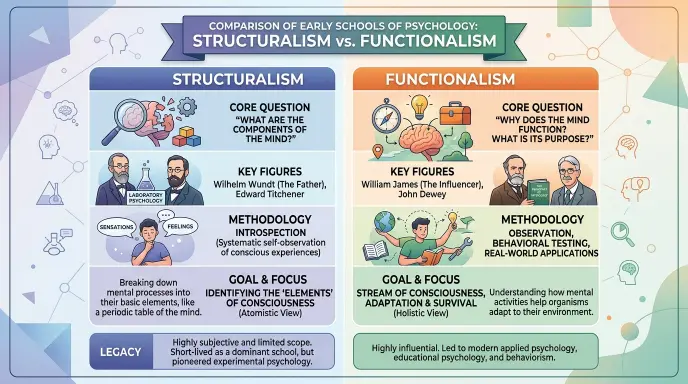
Structuralism vs functionalism describes a major debate in early psychology. Structuralism focused on identifying the basic components of conscious experience, while functionalism examined what mental processes and behavior do and how they help people adapt to their environment. Edward Titchener became closely associated with structuralism, while William James was a major figure in functionalism.
Key Takeaways
- Structuralism studied the basic elements of conscious experience.
- Functionalism focused on the purpose and adaptive function of mental processes and behavior.
- Edward Titchener is most closely associated with structuralism in the United States.
- William James was a leading figure in functionalism.
- Both approaches helped establish psychology as a scientific field, although neither remains a standalone school of mainstream psychology today.
What Is Structuralism in Psychology?
Structuralism was one of the earliest schools of psychology. Its main goal was to understand the structure of conscious experience by breaking it down into simpler components.
The approach is closely associated with Edward Titchener, a psychologist who studied in Germany and later developed structural psychology at Cornell University in the United States. Wilhelm Wundt also played an important role in the early experimental study of consciousness, but it is more precise to associate the formal label structuralism with Titchener rather than treating Wundt and Titchener as having identical theories.
Structuralists wanted to understand questions such as:
- What are the basic elements of conscious experience?
- What sensations make up a particular experience?
- How can different mental elements be described?
- How do these elements combine to create conscious experience?
For example, instead of simply asking why someone enjoys eating an apple, a structuralist might examine the individual sensations involved: its color, taste, smell, texture, and other elements of conscious experience.
Edward Titchener and the Development of Structuralism
Titchener developed his approach after studying under Wilhelm Wundt in Germany. He later brought this tradition to the United States and made introspection central to structuralist research.
This historical distinction matters because introductory psychology textbooks sometimes simplify the history by calling Wundt the founder of structuralism. Wundt certainly studied conscious experience and influenced Titchener, but Titchener’s structuralism was a more specific development of the broader experimental tradition associated with Wundt.
Introspection as a Method
Structuralists commonly used introspection, a form of trained self-observation in which participants reported their conscious experiences in response to controlled stimuli.
Researchers attempted to make introspection systematic by using trained observers and carefully controlled conditions. Even so, the method had an important problem: conscious reports were difficult to verify objectively, and different observers could report different experiences.
This subjectivity became one of the major weaknesses of structuralism.
What Is Functionalism in Psychology?
Functionalism focused less on the individual components of consciousness and more on what mental processes and behavior do.
The approach became strongly associated with William James, although other psychologists, including John Dewey, James Rowland Angell, and Harvey Carr, also contributed to functional psychology. Functionalism was influenced heavily by Charles Darwin’s theory of evolution and the idea that characteristics can help organisms adapt to their environments.
Instead of asking only, “What is consciousness made of?” functionalists were more interested in questions such as:
- What purpose does a mental process serve?
- How does behavior help an organism adapt?
- Why do people think, remember, learn, or pay attention?
- How does consciousness help an individual deal with changing circumstances?
William James and Functional Psychology
William James was a major figure in the development of American psychology. His influential book The Principles of Psychology, published in 1890, helped shape the direction of psychological thought in the United States.
James viewed consciousness as an ongoing process rather than something that could easily be divided into fixed pieces. His approach therefore placed greater emphasis on the function and usefulness of mental activity.
Functionalists were also interested in a broader range of people and behaviors than the traditional structuralist laboratory approach. Their interests helped encourage research involving children, animals, individual differences, education, and practical applications of psychology.
Darwin and Adaptation
Darwin’s theory of evolution was particularly important to functionalist thinking.
If a behavior or mental process helps an organism respond effectively to its environment, functionalists could ask how that process contributes to adaptation.
For example, fear can be studied not only as a collection of conscious sensations but also as a process that prepares an organism to respond to potential danger.
That shift—from examining the components of experience to examining its purpose or function—captures the central difference between the two approaches.
Structuralism vs Functionalism: Key Differences
| Feature | Structuralism | Functionalism |
|---|---|---|
| Main focus | Structure and elements of consciousness | Functions of mental processes and behavior |
| Key figure | Edward Titchener | William James |
| Major influence | Experimental psychology and introspection | Darwinian evolution and pragmatism |
| Main question | What is conscious experience made of? | What does mental activity do? |
| Method | Primarily trained introspection | Multiple methods, including introspection and observation |
| View of mind | Emphasis on component elements | Emphasis on the whole and its functions |
| Adaptation | Not the central focus | Major focus |
| Practical applications | More limited | Strong interest in practical applications |
| Historical role | Helped establish systematic study of consciousness | Broadened psychology’s subject matter and applications |
The basic contrast is therefore structure versus function. Structuralism tried to analyze the components of conscious experience, whereas functionalism asked how mental activity operates and contributes to adaptation.
A Simple Example
Imagine that you hear a loud car horn while crossing a street.
A structuralist perspective might focus on the elements of your conscious experience: the sound sensation, its intensity, the associated feeling of fear, and the mental image or perception produced by the event.
A functionalist perspective would be more interested in what the mental process accomplishes. The sound attracts your attention, the perceived danger changes your behavior, and you quickly move away from the vehicle.
The first approach emphasizes what the experience contains. The second emphasizes what the experience does.
Similarities Between Structuralism and Functionalism
Although structuralism and functionalism are often presented as opposing schools, they also shared important characteristics.
First, both were concerned with conscious experience and mental activity. Neither approach simply ignored the mind.
Second, both contributed to the development of psychology as a distinct academic discipline. Wundt’s laboratory at Leipzig, established in 1879, became an important milestone in the development of experimental psychology.
Third, both approaches attempted to study psychological questions systematically rather than treating the mind solely as a philosophical problem.
They also influenced later developments. Functionalism, in particular, helped broaden psychology toward behavior, adaptation, education, individual differences, and practical research.
Strengths and Limitations of Each Approach
Structuralism
One important contribution of structuralism was its attempt to analyze conscious experience systematically. It helped establish psychology as a field that could investigate mental processes under controlled conditions.
Its main limitation was introspection. Private conscious experiences are difficult for researchers to observe independently, and different participants may describe the same stimulus differently. OpenStax notes that trained introspection still produced considerable subjectivity and limited agreement between observers.
Functionalism
Functionalism expanded psychology’s scope. Instead of restricting research to the components of conscious experience, functionalists considered how mental activity relates to behavior, adaptation, the environment, and practical problems.
Its broader approach also encouraged psychologists to study subjects and situations outside the narrow laboratory model.
However, functionalism was less like a single, tightly defined system than structuralism. It represented a broader collection of ideas and interests rather than one uniform method or doctrine.
Why Did Structuralism and Functionalism Decline?
Neither structuralism nor functionalism survived as a dominant standalone school of psychology.
Structuralism faced increasing criticism over the reliability and objectivity of introspection. As psychology developed, researchers increasingly relied on approaches that could study behavior and mental processes with more observable and testable methods.
Functionalism also gradually blended into other psychological traditions rather than disappearing because of one specific event. Its emphasis on adaptation, behavior, practical applications, and broader research questions influenced later developments in psychology.
In other words, these schools were historically important partly because their ideas were absorbed, challenged, or transformed by newer approaches.
Why These Early Schools Still Matter
Understanding structuralism and functionalism helps explain how psychology developed from philosophical questions about the mind into an empirical discipline.
Their debate also illustrates two questions that continue to appear in psychology:
What is a mental process made of?
and
What does that mental process accomplish?
Modern psychology generally does not operate as a simple choice between structuralism and functionalism. Instead, psychologists use many approaches and research methods to investigate cognition, behavior, emotion, development, neuroscience, and other areas.
The historical debate remains useful because it shows why psychologists began asking different kinds of questions about the mind.
Frequently Asked Questions
Who founded structuralism?
Edward Titchener is most closely associated with structuralism as a formal school of psychology, particularly in the United States. He was strongly influenced by Wilhelm Wundt, whose experimental work on conscious experience helped establish the intellectual background from which Titchener’s structural psychology developed.
Who founded functionalism?
William James is the psychologist most commonly associated with functionalism. John Dewey, James Rowland Angell, Harvey Carr, and other psychologists also contributed to its development. Functionalism was influenced strongly by Darwinian ideas about adaptation and the relationship between organisms and their environments.
Is functionalism the opposite of structuralism?
They are contrasting approaches, but calling functionalism simply the “opposite” of structuralism can be misleading. Structuralism emphasized the components of conscious experience, while functionalism emphasized what mental processes and behavior accomplish. Both were concerned with understanding psychological activity and contributed to the development of the field.
Which method did structuralists use?
Structuralists relied heavily on introspection, particularly trained introspection under controlled conditions. Participants were asked to report aspects of their conscious experiences in response to specific stimuli. The method was important historically but was criticized because subjective reports were difficult to verify consistently.
Are structuralism and functionalism still used today?
They are not generally treated as independent dominant schools of mainstream psychology today. Their historical ideas, however, influenced later psychological research. Functionalism’s interest in adaptation, behavior, and practical applications was especially influential in the development of later approaches.
Conclusion
The main difference in structuralism vs functionalism is the question each approach emphasized. Structuralism sought to understand the basic elements of conscious experience, while functionalism focused on how mental processes and behavior work and how they help organisms adapt to their environments.
Titchener became closely associated with structuralism, while William James became a central figure in functionalism. Although both schools eventually gave way to newer approaches, they played an important role in shaping the history of psychology and expanding the scientific study of the mind and behavior.