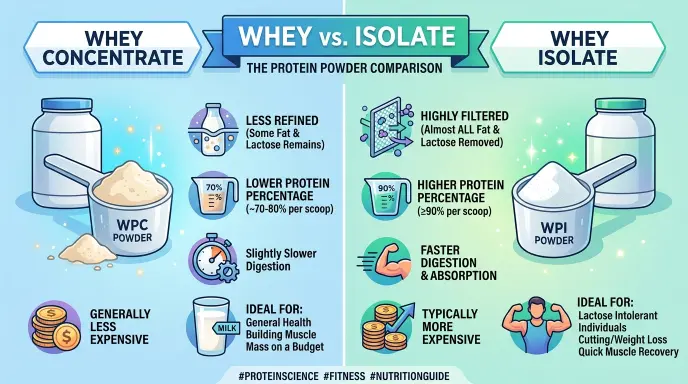
Whey vs isolate mainly comes down to processing and composition. Whey protein concentrate contains more lactose, fat, and carbohydrates, while whey protein isolate is filtered further and typically contains at least 90% protein on a dry basis with much less lactose and fat. Both are high-quality whey proteins that can help you meet your daily protein needs.
Key Takeaways
- Whey is a broad category, while whey isolate is a specific, more highly filtered form of whey protein.
- Whey concentrate generally contains more lactose, fat, and carbohydrates than isolate.
- Whey isolate typically provides a higher percentage of protein by weight.
- Both can support muscle growth and recovery when your overall protein intake is adequate.
- Isolate usually costs more, so the extra expense is most relevant if you want lower lactose, fewer calories from non-protein nutrients, or a higher protein concentration.
What Is Whey Protein?
Whey protein comes from milk. During cheese production, milk separates into solid curds and a liquid portion called whey. That liquid contains several proteins, which can then be processed, filtered, and dried into protein powder.
This is where the terminology can become confusing.
When someone says “whey protein,” they may be referring to whey concentrate, whey isolate, or a product containing a combination of whey proteins. So “whey vs isolate” is not technically a comparison between two completely different protein sources.
Instead, it is usually a comparison between whey protein concentrate and whey protein isolate.
What Is Whey Concentrate?
Whey protein concentrate (WPC) is whey that has been processed to increase its protein concentration while retaining some of the other components naturally present in whey.
Commercial whey concentrates can have different protein levels. The American Dairy Products Institute lists WPC products ranging from at least 25% protein, with WPC 80 among the common commercial forms. WPC 80 typically contains about 80–82% protein, along with lactose and fat.
This means concentrate isn’t simply “low-quality whey.” It is a high-quality protein that contains more of the non-protein components removed during additional filtration.
What Is Whey Protein Isolate?
Whey protein isolate (WPI) is processed further to remove more non-protein components.
The American Dairy Products Institute defines whey protein isolate as containing at least 90% protein on a dry-matter basis. Typical WPI composition is around 90–92% protein, with roughly 0.5–1% lactose and 0.5–1% fat.
That additional processing is the main reason isolate usually costs more.
Whey vs Isolate: Key Differences
| Feature | Whey Concentrate | Whey Isolate |
|---|---|---|
| Processing | Less extensive | More extensive |
| Protein concentration | Often around 80% for WPC 80 | Typically 90%+ |
| Lactose | Higher | Much lower |
| Fat | Higher | Much lower |
| Carbohydrates | Usually higher | Usually lower |
| Calories | Usually slightly higher | Usually slightly lower |
| Price | Generally lower | Generally higher |
| Dairy-derived | Yes | Yes |
| Complete protein | Yes | Yes |
Exact nutrition varies between products, so the Nutrition Facts or Supplement Facts panel is more useful than assuming every tub has identical numbers.
Protein Content
The biggest nutritional difference is protein concentration.
A WPC 80 ingredient contains roughly 80% protein on a dry basis, while whey isolate is generally at least 90%.
However, this does not mean every isolate gives dramatically more protein per scoop.
For example, one product might provide 24 grams of protein in a 30-gram serving, while another provides 25 or 27 grams. The serving size, flavoring, sweeteners, and other ingredients all affect the final numbers.
That’s why it’s better to compare the actual grams of protein per serving rather than simply choosing a product because the word “isolate” appears on the package.
Lactose, Carbs, and Fat
This is one area where isolate has a clear nutritional difference.
Additional filtration removes more lactose and fat from whey. ADPI’s typical specifications show WPI at about 0.5–1% lactose and fat, compared with substantially higher levels in WPC 80.
For someone who experiences problems with lactose, this difference can matter.
However, whey isolate is not automatically dairy-free. It still comes from milk and can contain milk proteins. People with a milk allergy should not assume that switching from concentrate to isolate makes whey safe for them. Cleveland Clinic also distinguishes lactose intolerance from milk allergy and advises avoiding whey products in the case of a milk allergy.
Calories
Isolate generally contains fewer calories from fat and carbohydrates because more of those components have been removed.
The difference is usually not enormous, but it can become useful if you’re carefully tracking calories and want to get a large amount of protein without adding as much fat or carbohydrate.
Still, don’t assume every isolate is automatically low-calorie. Flavorings, sweeteners, added ingredients, and serving sizes can change the final nutrition profile.
Processing and Digestion
Whey isolate undergoes more filtration than concentrate.
Some people find isolate easier on their stomach, particularly when lactose is the problem. Cleveland Clinic notes that isolate is consistently high in protein and low in fat or lactose and may be suitable for people with lactose intolerance.
But “isolate digests faster” should not be treated as a reason everyone needs isolate.
For most people, the more important questions are whether the product is tolerated well and whether it helps them consistently meet their protein needs.
Price
Whey concentrate is generally less expensive than whey isolate.
That price difference makes sense because isolate requires additional processing to remove more non-protein components. Healthline similarly notes that isolate generally costs more than concentrate.
Instead of comparing tubs by sticker price, calculate the cost per 25 grams of protein or another consistent protein amount. A larger tub is not necessarily a better value if it provides less usable protein per serving.
Whey vs Isolate: Which One Is Better for Building Muscle?
Both can be useful for building and maintaining muscle.
Whey is a complete protein source containing all essential amino acids, and whey protein is particularly rich in leucine. The NIH Office of Dietary Supplements notes that adequate protein provides the essential amino acids needed for muscle protein synthesis and that whey is a complete protein commonly used in protein supplements.
There is not strong evidence that simply choosing isolate instead of concentrate automatically produces greater muscle growth when comparable amounts of high-quality protein are consumed. Healthline’s evidence review likewise notes that there is not clear evidence that whey isolate and concentrate produce different effects in the body.
In practical terms, your total protein intake, resistance training, overall diet, and consistency matter more than the word “isolate” on the container.
Which Is Better for Lactose Intolerance?
If lactose is what causes your digestive symptoms, whey isolate may be easier to tolerate because it contains substantially less lactose than typical whey concentrate.
That said, tolerance varies from person to person, and isolate isn’t necessarily completely lactose-free. Check the product’s nutrition information if lactose is a major concern.
If you have a milk allergy, however, lactose reduction is not the same thing as removing milk proteins. Whey remains a dairy-derived protein.
Whey vs Isolate for Weight Loss
Neither whey concentrate nor isolate is inherently a weight-loss product.
The useful difference is their nutritional density.
Because isolate generally contains more protein relative to fat and carbohydrates, it can make it easier to fit protein into a calorie-controlled diet. Concentrate can also work perfectly well if its calories and macros fit your daily target.
The key is to look at the complete label rather than assuming that isolate automatically causes more fat loss.
How to Choose Between Whey and Isolate
Use your actual needs rather than choosing based on marketing.
Whey concentrate may make sense if:
- You tolerate dairy well.
- You want to spend less.
- You don’t need extremely low lactose or fat.
- You prefer a creamier taste or texture.
- You simply need a convenient source of high-quality protein.
Whey isolate may make sense if:
- You want a higher protein concentration.
- You’re closely tracking calories or macros.
- You want substantially less lactose.
- Concentrate causes digestive discomfort related to lactose.
- You’re comfortable paying more for those nutritional characteristics.
If you are unsure, compare two products side by side. Look at protein grams, serving size, calories, carbohydrates, fat, lactose information, ingredients, and price per gram of protein.
Common Mistakes When Buying Whey Protein
Assuming “isolate” means better results
Isolate is more highly filtered, but that doesn’t automatically mean it builds more muscle.
Comparing tubs instead of protein
A cheaper tub isn’t necessarily cheaper per gram of protein. Compare products using the amount of actual protein you receive.
Assuming all “whey” products are concentrate
Some products use blends containing concentrate and isolate. Always read the ingredient list.
Ignoring lactose
If you have lactose intolerance, check the lactose information and your personal tolerance rather than relying only on the word “whey.”
Treating supplements like regulated medicines
In the United States, dietary supplements are not FDA-approved for safety and effectiveness before they reach the market. FDA places responsibility on manufacturers for meeting applicable safety and labeling requirements, while its oversight is primarily post-market.
For that reason, reading labels and considering reputable independent testing can be useful when choosing a supplement.
Frequently Asked Questions
Is whey isolate better than regular whey?
Not automatically. Whey isolate is more highly filtered and typically contains more protein with less lactose and fat. That can make it useful for people who want a leaner protein powder or have difficulty with lactose. But both concentrate and isolate can provide high-quality protein and support daily protein intake.
Does whey isolate have less lactose?
Yes. Whey isolate generally contains substantially less lactose than whey concentrate. ADPI’s typical specification for whey isolate is about 0.5–1% lactose, while WPC 80 typically contains considerably more. Exact amounts vary by product.
Is whey isolate better for muscle growth?
There is no strong basis for saying isolate automatically builds more muscle than concentrate. Both are high-quality whey proteins. If you consume an adequate amount of protein, the choice between them is more likely to come down to factors such as lactose tolerance, calories, price, and personal preference.
Is whey concentrate cheaper?
Generally, yes. Whey concentrate usually costs less because it requires less processing. Isolate undergoes additional filtration to increase protein concentration and reduce components such as lactose and fat, which generally raises production cost.
Can you use whey isolate for weight loss?
Yes, whey isolate can fit into a weight-loss diet, but it does not independently cause weight loss. Its higher protein concentration and generally lower fat and carbohydrate content can make it convenient when you’re controlling calories. Your overall calorie intake and dietary pattern remain important.
Final Takeaway
The whey vs isolate comparison is mainly about processing, protein concentration, lactose, fat, carbohydrates, and price.
Whey concentrate is generally less processed and more affordable, while whey isolate is filtered further to produce a higher protein concentration with much less lactose and fat. Both can provide high-quality protein for people who want to increase their daily intake.
If you tolerate dairy and want good value, concentrate may fit your routine. If you need lower lactose or tighter control over the non-protein components of your shake, isolate may be more useful. The best comparison is ultimately the actual nutrition label and your individual needs, not simply the name printed on the tub.

John Updike was an American novelist, poet, and critic, famed for Rabbit series, suburban insight, elegant prose, literary awards, and lasting influence on modern fiction, cultural social psychological realism punsora.com