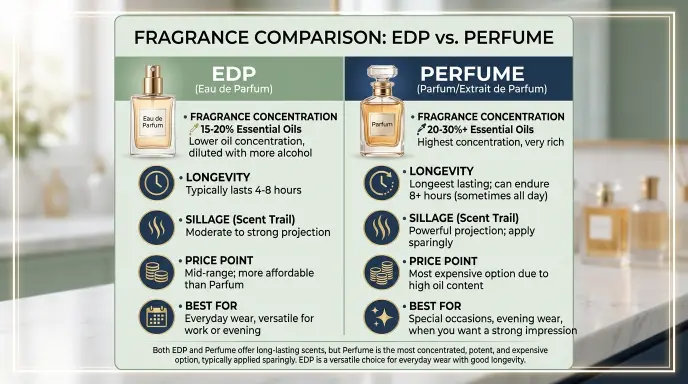
EDP vs Parfum mainly differs in fragrance concentration. Eau de Parfum (EDP) typically contains less aromatic concentrate than Parfum, while Parfum or Extrait generally contains more. Parfum often lasts longer and wears closer to the skin, but concentration does not automatically determine projection, scent quality, or which option is best for you.
Key Takeaways
- EDP means Eau de Parfum and generally has a lower concentration than Parfum.
- Parfum usually contains more fragrance concentrate and is often more expensive.
- Higher concentration can support longer wear, but it does not guarantee stronger projection.
- EDP and Parfum versions of the same fragrance may have noticeably different scent profiles.
- The better choice depends on the fragrance formula, your skin, climate, occasion, and personal preference.
What Is EDP?
EDP stands for Eau de Parfum. It is one of the most common fragrance concentrations available today. EDP contains a relatively high proportion of aromatic materials diluted in an alcohol-based carrier.
Industry conventions commonly place Eau de Parfum around the 10–20% fragrance concentration range, although actual formulations vary by fragrance house. IFRA emphasizes that terms such as Eau de Parfum and Parfum are not universally fixed international concentration standards.
EDP is popular because it generally provides a balance between noticeable scent, wear time, projection, and price. That makes it a common choice for everyday fragrances, work, social events, and evening wear.
However, EDP does not mean that every fragrance will perform the same way. Ingredients, formula design, application, skin chemistry, and environmental conditions can all influence the result.
Typical EDP Concentration
A commonly cited range for EDP is approximately 15–20% fragrance oil, but this should be treated as a general industry convention rather than a strict rule. Amouage, for example, notes that concentration ranges vary and describes its own EDP products as using a higher concentration than some industry averages.
This is important because shoppers sometimes assume that seeing “EDP” on a bottle guarantees a specific percentage or number of hours of longevity. It does not.
What Is Parfum?
Parfum, sometimes called Extrait de Parfum or simply Extrait, generally represents a more concentrated fragrance format.
DermNet describes parfum or extrait as typically containing about 20–30% fragrance concentration, while IFRA gives a broader common range for perfume extract of approximately 15–40%. The variation shows why it is better to treat these figures as conventions rather than universal formulas.
Because Parfum usually contains more aromatic material and less alcohol relative to the concentrate, it can feel richer and denser on the skin. It may also be designed to sit closer to the wearer rather than create a very large scent cloud.
Parfum vs Extrait de Parfum
The terms Parfum and Extrait de Parfum are often used interchangeably, but naming practices vary between fragrance houses.
Some brands use “Parfum” for a highly concentrated version, while others use “Extrait” for an especially concentrated formulation. There is no single universal percentage that every brand must follow.
So, when comparing two bottles, look at the actual product description and formula rather than assuming the label tells you everything about performance.
EDP vs Parfum: Key Differences
Concentration
The most basic difference is concentration.
| Feature | EDP | Parfum |
|---|---|---|
| Full name | Eau de Parfum | Parfum / Extrait |
| Typical concentration | Often around 10–20% | Commonly around 20–30%+, but varies |
| Alcohol proportion | Generally higher | Generally lower relative to concentrate |
| Typical character | Balanced and versatile | Richer and denser |
| Longevity | Often long-lasting | Often longer-lasting, but formula-dependent |
| Projection | Can be noticeable to strong | Often smoother or closer, but varies |
| Price | Usually lower | Often higher |
These ranges are industry conventions, not fixed international standards.
Longevity
One of the biggest reasons people compare EDP and Parfum is how long the fragrance lasts.
In general, a higher concentration can contribute to longer wear. DermNet describes parfum as typically lasting longer than EDP, although actual longevity depends heavily on the formula and wearer.
Still, you should not assume:
Parfum = always longer lasting.
A particular EDP can outperform a particular Parfum because fragrance composition matters. Ingredients that evaporate slowly, the structure of the formula, skin chemistry, temperature, humidity, and application technique can all influence longevity.
Projection and Sillage
Projection describes how far a fragrance can be detected from your skin, particularly after application.
Sillage describes the scent trail that can remain as you move.
These are not the same as longevity.
A Parfum may last for many hours but sit relatively close to the skin. An EDP can sometimes project more strongly during its opening even though it has a lower concentration.
This is one of the biggest misconceptions in the EDP vs Parfum comparison: more fragrance concentrate does not automatically mean a louder fragrance.
Amouage likewise notes that the relationship between concentration and performance is more complicated than concentration alone.
Scent Character
EDP and Parfum versions of the same fragrance may not simply be identical formulas at different strengths.
A fragrance house may adjust the formula, emphasize different notes, or change the balance between opening, heart, and base accords.
For example, an EDP might emphasize brighter or more noticeable opening notes, while a Parfum version could emphasize warmer, creamier, woody, musky, or deeper aspects.
This is why smelling both versions matters. Community discussions about fragrances such as Bleu de Chanel and Sauvage regularly highlight that different concentration versions can smell different rather than simply being stronger or weaker versions of one another.
Price
Parfum is often more expensive than EDP because it generally contains a greater proportion of fragrance concentrate. DermNet also notes that parfum is typically the most expensive concentration category.
But a higher price does not automatically make Parfum the better purchase.
If you prefer the smell of an EDP, wear it more frequently, or find that it performs well on your skin, paying extra for Parfum may not provide a meaningful advantage for you.
EDP vs Parfum Comparison: Which Is Different?
The simplest way to understand the difference is this:
EDP usually offers a balance of concentration, projection, longevity, and versatility, while Parfum generally emphasizes a higher concentration and a richer, often more intimate wearing experience.
Neither format automatically wins every category.
For example:
- Higher concentration: Usually Parfum
- Potential for longer wear: Often Parfum
- Potential for stronger opening projection: Either one
- More affordable: Often EDP
- Versatile everyday option: Often EDP
- Richer, concentrated experience: Often Parfum
The actual fragrance formula can change these patterns.
Is Parfum Stronger Than EDP?
Not necessarily.
If by “stronger” you mean more concentrated, Parfum generally is.
If by “stronger” you mean projects farther, however, the answer is not always Parfum.
Projection depends on the ingredients and formula as well as concentration. A highly projecting EDP can create a larger scent cloud than a subtle Parfum.
Think of concentration and projection as two related but different characteristics.
Which Lasts Longer: EDP or Parfum?
Parfum often has the potential to last longer because it generally contains more fragrance concentrate, but there is no universal guarantee.
Some EDPs perform exceptionally well, while some Parfums are intentionally designed to remain relatively close to the skin.
Your skin chemistry can also make a significant difference. A fragrance that lasts eight hours on one person may become difficult to detect much earlier on another.
For that reason, use published concentration information as a guide, not a promise of exact wear time.
EDP vs Parfum: Which Should You Choose?
The choice depends on how and where you plan to wear the fragrance.
Choose EDP When…
EDP may make sense if you want:
- A versatile fragrance for regular use
- A noticeable but adaptable scent
- Something suitable for work and social settings
- A balance between concentration and price
- A fragrance that works across several seasons
- A familiar version of a fragrance line you already enjoy
For many shoppers, EDP is a practical starting point because it is widely available and tends to occupy the middle ground between lighter and more concentrated formats.
Choose Parfum When…
Parfum may be worth considering if you prefer:
- A richer fragrance experience
- Higher concentration
- A potentially longer-lasting scent
- A smoother or more intimate dry-down
- A fragrance for evenings or special occasions
- The specific scent profile of the Parfum version
The key phrase is “the specific scent profile.” Do not buy Parfum solely because you assume it must smell better.
Does Higher Concentration Mean Better Performance?
No.
Higher concentration can contribute to longevity, but fragrance performance is more complicated.
A perfume’s ingredients, volatility, formulation, application, skin chemistry, temperature, humidity, and even how often you notice the scent yourself can influence perceived performance.
The industry itself does not treat EDP and Parfum labels as universal performance guarantees. IFRA explicitly explains that these terms are common descriptors rather than strictly standardized concentration categories.
That is why two fragrances with the same concentration label can perform very differently.
How to Test EDP vs Parfum Before Buying
If both versions are available, testing them on skin is usually more useful than judging them only from the bottle or concentration percentage.
Try this simple approach:
- Test EDP on one wrist and Parfum on the other.
- Smell both immediately after application.
- Check them again after 30–60 minutes.
- Compare them after several hours.
- Pay attention to the dry-down, not just the opening.
- Consider how far you can smell each version.
- Decide which scent you actually enjoy wearing.
Do not spray both directly on top of each other. That makes it harder to distinguish their individual development.
Frequently Asked Questions
Is EDP better than Parfum?
Neither is automatically better. EDP and Parfum can have different concentrations, formulas, scent profiles, projection, and prices. The right choice depends on the specific fragrance and how you want to wear it.
Is Parfum more expensive than EDP?
Parfum is often more expensive because it generally contains a higher proportion of fragrance concentrate. However, pricing also depends on the brand, ingredients, bottle size, positioning, and formulation.
Does Parfum last longer than EDP?
Parfum often has the potential to last longer, but concentration is not a guarantee. Formula composition, skin chemistry, weather, and application all affect longevity.
Can EDP project more than Parfum?
Yes. An EDP can project more strongly than a Parfum if its formula is designed to produce greater diffusion. Higher concentration does not automatically equal greater projection.
Is EDP or Parfum better for everyday use?
EDP is often a convenient everyday option because it balances noticeable fragrance with versatility. However, a Parfum can also work perfectly well for daily wear if you enjoy its scent and level of projection.
Conclusion
The main difference in EDP vs Parfum is fragrance concentration, but that is only the beginning.
EDP generally offers a balanced and versatile fragrance experience, while Parfum typically contains a higher concentration and may provide a richer, longer-lasting, more intimate dry-down. However, neither label guarantees a particular number of hours, projection level, or scent quality.
If you are deciding between two versions of the same fragrance, focus on how each one smells on your skin, how it develops over time, how much projection you want, and whether the price fits your budget. Concentration is useful information, but it should not be the only factor behind your choice.
John Updike was an American novelist, poet, and critic, famed for Rabbit series, suburban insight, elegant prose, literary awards, and lasting influence on modern fiction, cultural social psychological realism punsora.com